Occupy Faith

Occupy Faith
Click thru to site

LECTIONARY

LECTIONARY
Click thru to site

Friday, September 19, 2008

Thoughts for troubled times - 1

There are many things happening in our world
to give us pause for thought
environment and sustainability
surfeit and hunger
consumerism and financial security
individualism and community
war and peace.
While the problems abroad in the world may be new to this generation, the nations and peoples of the world have been troubled before. And, if the Lord tarries in His coming, such troubles may come again.
In this light, I thought it might be time to go back to another troublesome period in history, and look to some of the words of that period. So, beginning with this post, we will pay some brief visits to the words of Jeremiah. I hope these words can be taken to your heart, store there, reflected on, and perhaps they - in turn - will lead to further reading and reflection. Indeed, these are meant to be thoughts for The Journey.
~~~~~~~~~~~~~
".......I am watching over my word to perform it"
God's words to Jeremiah as a young man
Reported in The Book of Jeremiah 1: 11

Thursday, August 21, 2008

Choice: the Kingdom of God or Tyranny

This picture came from here

We can move in the direction of justice,
but if our personal relationships don’t become more human,
we haven’t moved in the direction of the reign of God
and, in the long run,
we will discover that our point of arrival is just another form of tyranny.

Wednesday, August 20, 2008


Great Spirit,
Give us hearts to understand
Never to take from creation's beauty more than we give,
Never to destroy want only for the furtherance of greed,
Never to deny to give our hands for the building of earth's beauty,
Never to take from her what we cannot use.
Give us hearts to understand
That to destroy earth's music is to create confusion,
That to wreck her appearance is to blind us to beauty,
That to callously pollute her fragrance is to make a house of stench,
That as we care for her she will care for us.
Give us hearts to understand We have forgotten who we are.
We have sought only our own security.
We have exploited simply for our own ends.
We have distorted our knowledge.
We have abused our power.
Great Spirit,
Whose dry lands thirst,
Help us to find the way to refresh your lands.
Great Spirit,
Whose waters are choked with debris and pollution,
Help us to find the way to cleanse your waters.
Great Spirit,
Whose beautiful earth grows ugly with misuse,
Help us to find the way to restore beauty to your handiwork.
Great Spirit,
Whose creatures are being destroyed,
Help us to find a way to replenish them
Great Spirit,
whose gifts to us are being lost in selfishness and corruption,
Help us to find the way to restore our humanity.

Sunday, August 10, 2008

The ancient Christian tradition of hospitality


I'm seeking to start a conversation on ancient Christian hospitality.

A couple of things have stimulated this.

1. My local parish (St Thomas) runs an Open Church program. It is quite simple. Its purpose is to keep our parish church doors open from 10am to 2pm Monday to Friday irrespective of whether there is anything on at the church. It is run by volunteers who staff the program with 2 volunteers operating in pairs and each pair doing two hours each - so that is four people every day Mon to Fri. This means our chapel is open for prayer/quiet times. In winter a back pew is made comfortable with cushion, blanket and heater! The volunteers are happy to give a coffee to any one who drops in and have a chat with them as well. Emergency food parcels are available for those who need them - although like any organisation who provides such a service, there are some boundaries.

2. Anti-Poverty Week is coming up in Australia from 12-18 October. I am on the Christian sub-committee here in Victoria. I have been trying to think how I might be able to stimulate involvement and interest in this. What I would like to do is to have St Thom's through the Open Church ministry host a multi-faith day for our area with an emphasis on Hospitality within the different faith traditions. I believe it would give a profile to our Open Church program so that others might imitate it and so we might have fewer locked up churches in Melbourne. There might be other faith communities who have their buildings closed during the week who might consider how they could keep their buildings open to the community. And, of course, hospitality spins off into meeting with those at the margins, getting to know them, serving them and thus serving Christ.

In focussing on Hospitality I also have a hidden agenda and that is that our program at St Thom's might come to a deeper understanding of the role and function of hospitality within our tradition and how that tradition impacts us in our Christian walk and how, through hospitality, we might impact the lives of others.

I am aware that, for instance, the Benedictines have an ancient tradition re hospitality which I would like to hear more about. I have heard that locking doors goes against the ancient Christian tradition. Does anyone know about this? I am sure there is more that can be said - so I wonder if you could help me to learn more about hospitality in our tradition so that I can get a clear and deep focus on it to the extent that I am able to articulate this clearly to others. Documents that I could pass on to others to read might be a help as well.

Friday, August 08, 2008

Justice is always associated with the desert experience


Photo: The Sydney Morning Herald

Jarrod McKenna, our energetic peace-loving peace-making Aussie, has written over here of a great Olympic story. It is the story of a prophetic and public moment in the lives of three Christian men. Two of these men were black Americans. The third, a white Australian. The white Australian was Peter Norman.

What Jarrod didn't mention was that when Peter died in 2006, the solidarity of the three men that was so publicly and irrevocably evident at the Mexico Olympics in 1968 was evident once again. Tommie Smith and John Carlos were here in Melbourne for Peter's funeral and they helped to carry his coffin.

Dear Reader, you have no idea how much this meant to us in Australia. That such athletic comrades from almost forty years ago should do such honour by coming half-way around the world will not be easily forgotten by Aussies.

To-night, I will watch the opening ceremony of the historic Beijing Olympics. I am a great admirer - in spite of things that get in the road sometimes - of the Chinese, their history, their culture and above all the Tao Te Ching. I am conscious of Australian's long involvement with the Chinese people. But if, like our Prime Minister, I could be a forthright friend: there are issues of justice in China and some of its relationships which can be difficult to overlook. Some people, perhaps, at these Olympics will feel strongly enough to make a public - and possibly prophetic - stand.

I pray that if this is the case that such people will remember the time forty years ago when three men decided to make their stand: representing two very different cultures these men really stood for something. The speedy and gentle Australian did not raise a fist. He wore a badge and, with Christ in his heart and his motivation, stood beside his black brothers. After all, Jesus said, where two or three are gathered in my name: there I am in the midst of them.

Wednesday, August 06, 2008

Transfiguration

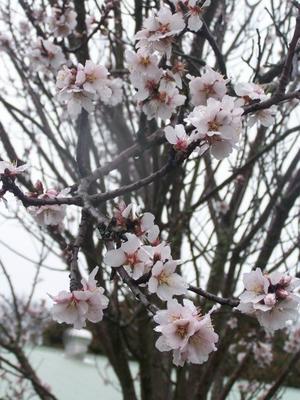
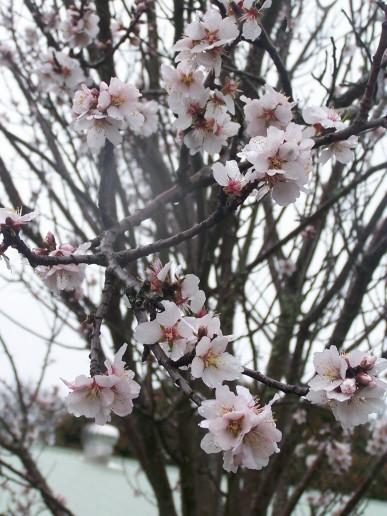
To-day is the Feast of the Transfiguration. Three years ago, the fruit tree beside my home office window was covered in blossom (the picture is from 2005) but my fruit trees have very few blossoms at this time and my magnolia seems to have blossom as a permanent condition since they have been there so long without flowering.

In the Northern Hemisphere, Easter coincides with new life in nature. In the Southern Hemisphere, Easter happens in Autumn when the leaves are falling and nature prepares for Winter.

I love the Feasts but, on those occasions when we observe those that are not Easter and Christmas, I think we talk about them in a way which does not give any depth to the experience. I think that, in the main, this is how the Transfiguration is treated.

The Transfiguration was a supernatural event intervening in the natural order of things. It was transforming and predictive of the new life to come. Just like the Southern Hemisphere is experiencing at this time. How wonderful then if people in the south of the globe could take this great season of the soul and transform it to mirror the wonder of regeneration that is happening in the environment. We could then experience both the transfiguration of our environment and of our spirits.

The Transfiguration Lyrics


~~~
When you can do nothing else: bear witness.

Tuesday, July 29, 2008

A monastery of her own

The role of the older single woman in society has always been surrounded by ambiguity - particularly post-menopause. In fact, we do well to remember that until just over one hundred years ago the pattern of a woman's life was to go from her father's house directly to her husband's house - except for the occasional exceptions where a woman entered a nunnery.

The formerly married single woman - in other words, the widow - has always been difficult and all the more so if she had dependent children. No longer virginal, a woman with sexual experience, and, once post-menopause, frequently seen as sexless. Now if this woman was not submissive and self-effacing and 'modest', she might be seen as dangerous, as a troublemaker, and - in some periods of history - a witch.

So what to do with such women? It is only in the last fifty years that most of us have controlled our fertility sufficiently to establish true independence - personal and economic. Prior to that, our biology was a factor in our dependency on the male of the species one way or another and a factor in the male ability to control women.

As an older woman, a widow, I have often thought of what it might mean to live in an intentional community with other women like me for mutual support. The sort of thing I have in mind would be be living independently in a building suitable for the purpose but having communal periods and, because we would be an intentional community, able to give our energies to projects that we were unable to carry out individually.

However, there are few totally new ideas in this world. No new thing under the sun, Ecclesiastes 1:9 says. Because, dear Reader, in medieval times someone actually thought of that and did it.

All those blokes, well probably the best of the blokes, went off to the Crusades and left the women at home - widows in every meaning of the word except death of husband although that might have happened and the news not yet arrived. Some women were single and could not marry because of the lack of men and some were deserted while the men did their "spiritual" duty. Out of this social milieu, came the Beguines. They were later to be followed by a male equivalent, the Beghards but, in this instance, the women led the way.

I was reminded of this when dipping into the Travel section of The New York Times and found this beautiful piece: A Lost World Made By Women. Sadly, the Beguines have gone from among us and their buildings live on as relics of an anachronistic idea.

But, you see, I don't think the idea is anachronistic. I think the idea could become a contemporary ideal for many women bearing in mind the words of the the Franciscan Friar Gilbert of Tournai in 1274:
There are among us women whom we have no idea what to call, ordinary women or nuns, because they live neither in the world nor out of it.

The Beguines and their story/ies give us much food for thought. Their ideal need not and should not be lost to us. But we need to learn lessons from their experiences:
  • recognize how easily independent, autonomous women threaten male hierarchies, particularly clerical ones;
  • provide structures for ourselves of ourselves that ensure we can act in a way that is true to ourselves so that we are susceptible neither to co-option nor marginalization;
  • discover what beautiful intellectual structures we can build for ourselves when our own feminine leanings and desires are given free rein.

Wednesday, July 16, 2008


Jesus sowed his seed in our hearts, then off he went....
He knew things would not be ideal.
There were the birds and the droughts,
the weeds and the insects,
the parasites and the blights.
But there was also the power of the seed itself.
Joseph G. Donders
teacher and chaplain
at the University of Nairobi, Kenya

Friday, July 11, 2008

The Word and Community

The lack of a caring community
that incarnates the Word
makes us more and more incapable of being heard.

Filipino theologian

Thursday, July 10, 2008

Contemplation, Witness, Resistance

Christine Valters Paintner over at the Abbey of the Arts has given us a link to her article: The Practice of Contemplation as Witness and Resistance. Please take time out to read this since it provides a balanced view of the contemplative life in modern practice. Such a life is not mere navel-gazing but the seeding of an active, prophetic life. The post is here.

Wednesday, July 09, 2008

I have snitched this quote from Sacred Threshold who seems to have got it from inward/outward. It is from Henri Nouwen.

You are Christian only so long as you constantly pose critical questions to the society you live in, so long as you emphasize the need of conversion both for yourself and for the world, so long as you in no way let yourself become established in the situation of the world, so long as you stay unsatisfied with the status quo and keep saying that a new world is yet to come. You are Christian only when you believe you have a role to play in the realization of the new kingdom, and when you urge everyone you meet with holy unrest to make haste so that the promise might soon be fulfilled. So long as you live as a Christian you keep looking for a new order, a new structure, a new life.

Desert spirituality: definition and experience.

A beautiful post on the definition and experience of desert spirituality at Theguyoutsidethewalls.

Friday, June 27, 2008


We search and we search and yet find no meaning.
The search for a meaning leads to despair.
And when we are broken the heart finds its moment
To fly and to feel and to work as it will
Through the darkness and mystery and wild contradiction.
For this is its freedom, its need and its calling;
This is its magic, its strength and its knowing.
To heal and make meaning while we walk or lie dreaming;
To give birth to love within our surrender;
To mother our faith, our spirit and yearning;
While we stumble in darkness the heart makes our meaning
And offers it into our life and creation
That we may give meaning to life and creation
For we only give meaning we do not find meaning:
The thing we can’t find is the thing we shall give.
To make love complete and to honour creation.

Leunig
in When I talk to you: a cartoonist talks to God
2004, HarperCollinsPublishers

Saturday, June 21, 2008

The Light in Mid-Winter: a story for the winter solstice


THE LIGHT IN MID-WINTER
A story for the Winter Solstice


The Earth is in winter once again. The Sun gets out of bed later to find the Day and tucks itself away earlier to bring Night.

But there is a place that we can’t touch or feel. We scarcely notice it when it is come and it is gone. It is Mid-Winter. The Winter Solstice. This is a very special time. Before this time the hours of The Sun are getting shorter and shorter. After this time, the hours of The Sun are getting longer and longer. Or we can think of it another way. Before Mid-Winter the hours of Great Darkness are getting longer and longer. After Mid-Winter the hours of Great Darkness are getting shorter and shorter.

The Sun is s-o-o important to us. It is the bringer of Life and Light. When we put our plants in the ground to grow our food, to produce beautiful flowers, and start big shady trees on their journey of life – our effort will be wasted if there is not Light. We need Light to live. And while plants and animals and human beings have adjusted and adapted to living with cold in most places on The Earth, we do need Warmth. The Sun gives us Warmth. Our life is in Light and Warmth – not in Dark and Cold.

Our bodies love to be warm. They do not like to be shivery cold.

But it is not just our bodies. We human beings are not just our bodies. We are spirit too. And sometimes, in our spirit, we do not feel warm. Sometimes, in our spirit, we do not feel full of Life and filled with Light. We feel the Dark and the Cold coming inside of us and this does not make us feel happy. Instead, we feel s-o-o sad. We don’t want to get out of bed. We don’t want to talk to people. We want to huddle into ourselves because the sunny parts of our lives feel as if they have gone away never to come again.

So what do we do when we feel dark in our spirit?

It helps to look around at the world created for us. When we make a garden we have to think of all that a plant needs. This includes thinking about the Light. If the garden is too shady because of big trees, we have to prune and shape the trees. The plants in our garden will receive more Light to grow.

We look at our spirit in the same way. We do this by sitting quietly. We sit quietly so that the spirit inside us can listen. We sit quietly so that the spirit inside us can be still and not disturbed. As we still our spirit inside us, it is like pruning and shaping that big shady tree. As we are sitting, as we are still, as we are quiet we find the Light comes to our spirit just as the Light comes to our growing plants.

A long time ago a man called George Fox learned about the Light. He said then – and his words have come down to us to this very day – I saw an ocean of darkness and death BUT – and this is a great, lovely, big BUT – and infinite ocean of light and love which flowed over the ocean of darkness.

Monday, May 05, 2008

Good Friday in Upper Gully

Good Friday in Upper Gully is an ecumenical affair. Three churches - St Thomas (Anglican), St John the Baptist (Catholic) and the Uniting Church - join together for their Good Friday service. The service is at a different church each year. This year the service was a very special Stations of the Cross at the Uniting Church in the village of Ferntree Gully.

Miss Eagle thinks it was rather wonderful that a such a wonderful meditative exercise like the Stations of the Cross - which has been such a very, very Catholic tradition - was shared so beautifully and co-operatively by the three traditions.

BubbleShare: Share photos .

Thursday, March 20, 2008

Seasons of the soul: A peak experience: the three days of Easter

As I write late on the afternoon of Maundy Thursday, it is with the anticipation of embarking on keeping alive the remembrance at the pinnacle of the Christian faith within the cycle of the liturgical year - the Easter Triduum.

The Easter Triduum refers to the three days from the evening of Thursday through to Sunday evening. It also refers to the three major events around which the community of faith gathers: the commemoration of The Last Supper on Maundy Thursday; the commemoration of the suffering and death of Our Lord and Saviour Jesus Christ on Good Friday; and the celebration of His Resurrection on Easter Sunday. Holy Saturday, the day between Good Friday and Easter Sunday, is a day of quiet and mourning remembering that this was the time that Jesus lay in the grave.

I was thinking to-day that I have kept these traditions for sixty years. Sometimes the Triduum has not been kept in its entirety when health matters have intervened. This has happened a lot over the last decade. But health has improved and I am looking forward to full participation this year.

To-night will be the washing of feet. Last year, this was done with towels and soap and bowls from our local public hospital where St Thom's has a huge and long involvement in chaplaincy and pastoral care. Great symbolism! To-morrow, we go ecumenical joining with the Catholic and Uniting Church in procession and ceremony. Sunday, St Thom's starts at 6.10am with the sun and kindling the new fire followed by breakfast followed by the great rejoicing as the purple disappears and the Gloria that hasn't been heard for six weeks rings out. "He is risen!" is the greeting of the day with the response of "He is risen indeed!". Miss E will be following this with a trip into the Hills to the tiny Quaker Meeting for Worship at Menzies Creek.

Friday, February 22, 2008

Christians Against Terrorism walk free and acquitted!

Free at last. Ruddock’s rotten rules couldn’t hold them. Read all about it here.Congratulations one and all. Miss Eagle is glad that your ordeal is over. God go with you into a new day!

Wednesday, February 13, 2008

Sorry, forgiveness, and anew beginning

Sorry

To-day is an historic day for the Commonwealth of Australia. In the Parliament of the nation, in Canberra, Prime Minister Kevin Rudd will apologise to the Aboriginal people of this nation continent for the mistreatment of Aboriginal people since European settlement began in 1788. Above all, he will apologise for the forced removal of children from their families and communities - an episode referred to as The Stolen Generations.

There has been great demand for an apology since the recommendations handed down in the Bringing Them Home report. Prime Minister John Howard, Prime Minister from 1996-2007, refused to apologise. Howard - a mean-spirited, conservative, and stubborn man - merely expressed regret but went on to promulgate the lie that no ill-treatment was carried out in living memory.

One positive effect of Howard's inaction in this matter has been to increase resolve on the part of countless Australians to see the apology carried out. Most Australians want to resolve the issues and hatreds and maltreatments of the past. We do not want the bitterness, the recrimination to continue. We want to give expression to a new way doing things which is informed by the knowledge of our history good and bad. Australians want an inclusive nation - and certainly not one where the Aboriginal people are fringedwellers socially and economically.

And so yesterday a new beginning was made with the opening of the new Parliament. For the first time in Australian history, Aboriginal people were at the centre of the ceremonial inaugurating the new parliamentary term with a Welcome to Country ceremony. Prime Minister, Kevin Rudd, and Leader of the Opposition, Brendan Nelson, both made clear that as long as they had anything to do with it, Aboriginal ceremony would become an integral part of the Opening of Parliament.

To-day, Aboriginal people will stand with the Prime Minister on the floor of Parliament for the delivery of the apology. The text of the apology, set out below, was tabled in Parliament yesterday and the apology is the first item of business in the new parliamentary term.

From time to time, on this blog, Miss Eagle has discussed the topic of public forgiveness. It has been discussed in the context of public figures apologising, saying sorry. How then does the public respond to that apology and advise if there is an acceptance of the apology and whether forgiveness is the response?

After the apology to-day, Miss Eagle expects that we will enter - for a time - the realm of public forgiveness. The apology will be discussed. We will hear critiques and criticism. We will find out who is satisfied with and by it and who is not. To-day we formally enter the time of new beginnings - of repair and building. All Australians are not at the same place on this matter. But enough of us are to carry the day throughout the nation, to demand inclusion, to demand involvement so that Aboriginal people are do-ers, not done to: so that they are self-determining actors in their own story and that all Australians - settlers and Aboriginal people together - will build a new and equitable way of operating to bring that great tradition of a fair go to everyone.

THE APOLOGY

Today we honour the Indigenous peoples of this land, the oldest continuing cultures in human history.
We reflect on their past mistreatment.
We reflect in particular on the mistreatment of those who were stolen generations - this blemished chapter in our nation's history.


The time has now come for the nation to turn a new page in Australia's history by righting the wrongs of the past and so moving forward with confidence to the future.

We apologise for the laws and policies of successive Parliaments and governments that have inflicted profound grief, suffering and loss on these our fellow Australians.
We apologise especially for the removal of Aboriginal and Torres Strait Islander children from their families, their communities and their country.
For the pain, suffering and hurt of these stolen generations, their descendants and for their families left behind, we say sorry.
To the mothers and the fathers, the brothers and the sisters, for the breaking up of families and communities, we say sorry.
And for the indignity and degradation thus inflicted on a proud people and a proud culture, we say sorry.

We the Parliament of Australia respectfully request that this apology be received in the spirit in which it is offered as part of the healing of the nation.
For the future we take heart; resolving that this new page in the history of our great continent can now be written.
We today take this first step by acknowledging the past and laying claim to a future that embraces all Australians.
A future where this Parliament resolves that the injustices of the past must never, never happen again.
A future where we harness the determination of all Australians, Indigenous and non-Indigenous, to close the gap that lies between us in life expectancy, educational achievement and economic opportunity.
A future where we embrace the possibility of new solutions to enduring problems where old approaches have failed.
A future based on mutual respect, mutual resolve and mutual responsibility.
A future where all Australians, whatever their origins, are truly equal partners, with equal opportunities and with an equal stake in shaping the next chapter in the history of this great country, Australia.

Wednesday, February 06, 2008

Seasons of the Soul: Ash Wednesday 2008


THE LONG WATCH

I draw aside to-day:
into the quiet, the reflection
of the pool of life.

I watch the disturbance,
the stone of my being
cast into the timeless pool…

ripples moving outward
from the centre
of the sunken stone…

circular disturbances
of small circumference
enlarging to a fading edge.

The rippling of my life
is energy into stillness
moving beyond its entry point.

The ripples, equilibrium disturbed.
The still centre sinks
under the surface.

Rippling circular to centre.
Never a straight line,
never trajectory altered.

The disturbance continues
outward…
Until, far from its centre,
it ceases.


Brigid O’Carroll Walsh
Ash Wednesday 2008
6 February 2008
© 2008

Tuesday, January 01, 2008

Living in life: renewal and creation

For the "new man" everything is new. Even the old is transfigured in the Holy Spirit and is always new. There is nothing to cling to, there is nothing to be hoped for in what is already past - it is nothing. The new man is he who can find reality where it cannot be seen by the eyes of the flesh - where it is not yet - where it comes into being the moment he sees it. And would not be (at least for him) if he did not see it. The new man lives in a world that is always being created and renewed. He lives in this realm of renewal and creation. He lives in Life.

Thomas Merton. "A Search for Solitude." Journals, Volume 3. Lawrence S. Cunningham, ed. San Francisco: HarperSanFrancisco, 1997: 269

Monday, December 31, 2007

The Incarnation: Jesus and vulnerability

~~~~~~~~~~~~~~~~~~~


FIRST SUNDAY AFTER CHRISTMAS: DECEMBER 30, 2007

Isaiah 63: 7-9 Psalm 148 Hebrews 2: 10-18 Matthew 2:13-23


FOLLOWING JESUS


Preached by Rev John Simpson, St Thomas Anglican Church, Upper Ferntree Gully, Victoria


Author Peter Lord, was skiing in Colorado and saw some people wearing red vests with the words ‘BLIND SKIER’ on them. He thought, ‘I have a hard enough time skiing with two good eyes, how can they ski successfully with none?’ The answer was – they had a guide whose instructions they totally trusted and followed! As the guide skied beside them, he’d tap his ski poles together to assure them he was there. Then he’d say, ‘Go right! Turn left! Stop! Slow! Skier coming up on your right!’

What a picture. Life is like skiing downhill blind. We can’t even see five seconds into the future or the struggles to come

Following Jesus is like that. It is like skiing blind with only him to be alongside of us, to guide us. When Jesus was born, Mary and Joseph were living like this; new borns revolutionalize parent’s lives. And he did this to them. Then it was not long before they had to go with Jesus to Egypt to protect his life, the fragile and vulnerable life of an infant. Following the visit of the wise men to Jesus, Joseph is told to take him away, because Herod was seeking to kill him.

Herod was known for his ruthlessness and murderous acts. He had three sons killed to keep his crown. The Roman masters were equally as ruthless. They were known to raze a whole town and kill all that lived there, to warn other local towns. So for him to spill blood to keep power, did not bother him. It’s estimated that twenty children died within days. Matthew seeking to understand this by quoting an Old Testament passage of Jeremiah: “A voice was heard in Ramah, Rachael weeping and sobbing and loud lamentations.”

Often these ‘fulfilments' of the OT were allusions to already fulfilled prophecies, more like a poetic reflection. Then Joseph has two more dreams in which he is told to return to Israel, which he does. But on learning that one of Herod’s sons is ruling there, he takes the family into Galilee and the obscurity of Nazareth. Again Matthew sees in this an OT fulfilment, “He shall be called a Nazorean.”

He is trying to make sense of what this means if you follow Jesus the Christ. Basically I think he’s indicating to us: that God’s plan to restore us to himself will not be thwarted by evil.

As present day followers of Jesus, when we are confronted by evil, such as we’ve seen in this century, we are to “hold fast to our confidence in God and not give it away” (Hebrews 10 my paraphrase). To follow Jesus Christ we will have to go through the minefields of life, knowing that Jesus can show us how to negotiate our way, without loss of compassion; and actually doing something to help. Jesus, like the skiing instructor, will be alongside of us as we walk ‘blind’, by faith in him.

Following Jesus in vulnerability

Joseph and Mary were the equivalent of modern day refugees seeking safety in Egypt, from Herod’s cruelty. He takes his family there in obedience to the angelic message. Then again he is told to return; this time however he finds that one of Herod’s sons is ruling. So he goes to little known Nazareth, out of the way of Herod’s spies. Jesus coming was not free from the evils and heartaches that assail us. He, like us, is a vulnerable human being.

God did not give a special kit of things to protect him in his vulnerability – for that would have meant that he was not fully human. Instead the writer to the Hebrews tells us that:

Since the children share flesh and blood, Jesus himself shared the same things
Through death he destroyed the one who has the power of death…and freed all who all their lives were held in slavery, by their fear of death
Although he was a Son, he learned obedience through what he suffered.

This is a very different Lord Jesus to the one I was raised on – the One who appeared in those lovely pictures with him surrounded by adoring children. God took an immense risk in making Jesus to be fully human. He did not come protected by special influences emanating from his Divinity. Rather he meets the times of trial, the force of evil; with the same help each of us now have.

Think on this, The Christ of God was vulnerable because he shared in our flesh, flesh that had become so connected to sin. God lets him feel the full force of trials and suffering. To follow him means we have to hold fast to him in faith, and not be discouraged by evil, like the killing of Ms Bhutto, nor shrink back when the going gets tough. The late John Macquarrie, an Anglican Theologian of great note, speaks of Jesus facing the full force or brunt of human life, as “God’s letting-be”. Parents come to this, when they know they have to let go and let their young ones, meet their own challenges and live with them. God’s letting-be is not a passive thing. Rather it is God giving us the room to find and live out our life. God does not crowd us with good advice or keep trying to persuade us to do things his way! By giving us room, we find our true selves – warts and all!

Following Jesus is to let this vulnerability be, to follow its way, and so mature. It does not mean that I will not grieve or not ask him, “How come, God!?”

Following Jesus in the struggle

An article in the Age last Monday, headed ‘A man worth emulating’ was by a secular Jew, Leslie Cannold. In looking at the Jesus story she ventured that he was an outsider, one of the poor of his day, and considered illegitimate. Leslie sees Jesus as there for the needy, suffering, and lost among his own people. Others try to re-write the Story according to their culture. Often this reduces Jesus to a nice guy. The South American liberation theologians rightly see in Jesus, one who comes to liberate people from all that oppress them. He was on the edges of his society, considered from the point of wealth and power.

Yet this was and is his strength – his ability with the struggles of people, to fight against the temptation of the quick fix, to refuse the satan’s offer of quick power by worshipping it. He tasted all that is human, so that he could renew our human-ness. God plunged him into non-religious life, as a child with suspicion that he was born the wrong side of the bed sheets; the religion of the poor was looked down upon by the religious leaders. And they were powerless in the face of Rome. However he starts his ministry with the declaration that challenges religious protocols – “I have come to bring good news to the poor, release for the captives, to set at liberty those in darkness….” I wonder what Jesus would say about the dark episode in Australian politics, of the treatment of David Hicks?

Jesus struggles with these issues and had obviously thought them through. Full humanity for him meant:
Going to the unclean, lepers and tax-collectors; having women disciples including his mother, and some women who supported his work; going into pagan territory, healing many there, and finding more faith in them than among his own people. Some even suggest that he married that woman – Mary Magdalene!

Following Jesus has taken me out of my religious world. A friend remarked to me, after I’d been ordained some years, “john, you now swear, go to the pub for a drink and even tell risqué jokes!” I did not take this negatively! It was a part of my tasting the full humanity, following Jesus had shown to me.

Some years ago Chris and I were on holiday in Cornwall. We were walking down a country lane towards a bus stop; the wind was so strong you could lean into it. We stepped out of the wind’s force and sought relief. That was good. However we never moved…..forward. To grow like Jesus we have to meet the full force of the winds of life.

Conclusion: Following Jesus asks no more than that I love him with my all
Be vulnerable to all that is human
Be a struggler in the way of Jesus so as to minister to others

Another way of saying this is this prayer:
Day by day, Dear lord, three things I pray:
To see you more clearly;
To love you more dearly;
To follow you more nearly, Day by day.

Sunday, December 16, 2007

Wisdom - an inclusive view


Abhipanya at with bowl and robe has a post with which I resonate. How I wish more people in my immediate community of faith could background themselves with such wisdom to advance our conversation more! And I hope I can have such self-insight that will enable me to take the conversation further, too.

Advent 3: Gaudete Sunday: Rejoice - and again I say rejoice

To-day takes on a rosy hue. It is Rosy Sunday. Gaudete Sunday. Rejoice. Light the pink, rose coloured candle on the Advent Wreath.
Mary's response to the Angel
My soul doth magnify the Lord / and my spirit hath rejoiced in God my Saviour.
For he hath regarded / the lowliness of his handmaiden.
For behold, from henceforth / all generations shall call me blessed.
For he that is mighty hath magnified me / and holy is his Name.
And his mercy is on them that fear him / throughout all generations.
He hath shewed strength with his arm / he hath scattered the proud in the imagination of their hearts.
He hath put down the mighty from their seat / and hath exalted the humble and meek.
He hath filled the hungry with good things / and the rich he hath sent empty away.
He remembering his mercy hath holpen his servant Israel / as he promised to our forefathers, Abraham and his seed for ever.

Saturday, December 15, 2007

Simon Barrow
Simon Barrow has to be one of the busiest - and most talented - people around. He is Co-Director of Ekklesia. I am indebted to Simon and his blog, faithinsociety, for referring me to the wonderful thoughts of Reinhold Niebuhr expressed below. Simon, in turn, passed his thanks to Jane Stranz who blogs at Of life, laughter and liturgy.

Reinhold Niebuhr
Nothing worth doing is completed in our lifetime, Therefore, we are saved by hope. Nothing true or beautiful or good makes complete sense in any immediate context of history; Therefore, we are saved by faith. Nothing we do, however virtuous, can be accomplished alone. Therefore, we are saved by love. No virtuous act is quite as virtuous from the standpoint of our friend or foe as from our own; Therefore, we are saved by the final form of love which is forgiveness.

Friday, December 14, 2007

Advent 2: Daring to Hope


SERMON PREACHED BY REV. JOHN SIMPSON
AT THE CHURCH OF ST THOMAS, UPPER FERNTREE GULLY
SECOND SUNDAY OF ADVENT : DECEMBER 9th 2007

‘Daring to Hope’

What a theme! Hope is when I have a confident expectation that keeps me going, while I wait and work for it to come to pass! Remember the ‘waiting’ message of last week? “Practice creates Miracles”. I wait confidently; yet hope also calls me to dare to do something towards it.

I Practice; take a few courageous steps into the unknown. Like when we decided to have our new (yet old) home renovated and took the builder's advice to do more! Or when I’m on the internet and looking for a site, and at the bottom of my screen the words “unknown territory” pops up. It’s exciting, yet it’s scary! I’m confident and venturing into the unknown.

When I was ordained I had lots of utopian ideas, like those found in the first reading.
Are these great visions of peace and harmony among peoples just a fairy tale? No; they correspond to the deep longings of the human heart and point to God’s ultimate goal for us. Such visions nurture our souls and our hearts. They give energy to keep waiting, practicing and daring.


John Baptizer. Jesus Messiah : The Darer and the Doer.

John dared people to “Repent, for the kingdom of heaven is at hand!” Matthew tells us that the Baptizer was the Voice, the Voice that dares all to “Prepare the way of the Lord, make straight his paths”. From his mother’s womb, John’s life was determined by his mission – for he is said to have leapt in her womb at the voice of Mary, the mother of the Doer, Jesus. His call was to prepare us. He did not seek personal fulfilment through his work. He came to make ready a people prepared for the Lord.

In our own place and circumstances, we each have a role to play. It calls for some ‘daring-do’. The divine will and purpose, like a link in a chain, depends on each of us obeying the role God’s given to us. Many great things depend on us remembering that we are children of God – that we are divine beings. John Baptizer did what God asked of him – he recalled people to their true nature. He went out daring to do this. Later we are told he did not know Jesus, until he saw a dove descend on him at Jesus’ baptism

And what a result! Allowing for some exaggeration, the whole region around the Jordan and people from Jerusalem and Judea, came out to hear him. Big turn-out! A bit like Christmas Day at Midnight! Yet that was only the beginning. As they heard him, people were said to be, “On the tip toe of expectation”- just what Advent can be for us as we practise our waiting. Many were baptized, acknowledging they’d “missed the mark”, through forgetting they were God’s. John Baptizer dared, and many had a burden lifted – not in the temple or by the priests – but in the desert and by the Voice and baptism water.

If John was the Darer, Jesus was the Doer: he also came to be baptized. Jesus did this to identify with John’s mission and with the people seeking God’s coming. Together they brought Hope into view. Hope became the people’s new Horizon. The Voice did his work. John Baptizer saw the utopian vision beginning – it must have been exciting to see folk coming with a longing to hear the word of the Lord. And doing it for themselves!

How daring was John?

John showed courage when he took on the Pharisees and Sadducees coming to his baptism.
“You brood of vipers! Who warned you to flee from the wrath to come? Produce good fruit worthy of your repentance.” They were quick to condemn the non-religious and I think John threatened them with his tongue in his cheek!

“Vipers”! They were slithering down to the Jordan, and John was not afraid of them, even if they were poisonous. That takes some daring-do! Have you ever spoken boldly to someone to make the point? I have a few times. I once told the son of a friend, who was on drugs, that he was on the “road to hell’. He agreed - though his parent’s friends thought I was wrong! His mum and dad did not!

“Who warned you to flee from coming wrath?” Not a concept we associate with Jesus and God. Can God be said to be wrathful, angry with us? John did. Maybe he had a point, that hypocrisy and not loving others, displeases God. Certainly Jesus got angry on several occasions. I prefer to think of wrath as my receiving the consequences of my own actions. “What you sow, you will also reap.” What goes around, comes around.

“And do not presume to say to yourselves, ‘ we have Abraham as our father’.” In other words, ‘whatever your family tree, you’re on your own, here boys!’ Each one must be responsible for him or her self. This is a strong theme in Jeremiah, Ezekiel and Elijah – the one John is most like, fiery and challenging. You’ve been baptized as children of God – so bear the fruits of this Baptism. Live like the divine beings you are.

Taking responsibility for yourself is what’s being dared here. It can be mighty uncomfortable. It’s almost like shedding your skin, as snakes do, so as to grow into a new one. Yet, Utopia will be made up of those who are responsible for themselves, ready to shed the old skin and dare to do.

Being a Darer-Doer
This is to be a people of hope, followers of the Jesus Way. Courageous and responding to the deep longings God has placed in your human heart. Daring to act from the vision. Courageously taking up the cross to bring new life. Boldly being a voice for the vision of love, harmony and Jesus the Christ. “Dare to be a Daniel, dare to stand alone”.


Here’s some ways : “Practise Creates Miracles” So try making these ones!

• Remember each day, say to yourself, “I am a son, a daughter, of the Living God – I’m divine. When upset or distressed, stop and be calm. Remember who you are. And let the life of Jesus flow!

• Speak tenderly whenever you “hear” the deep longings of another person’s heart, they are part of God’s plan, a step they can take to bring more of heaven to earth.

• Speak more boldly than you usually do, when you hear a person going down a road that leads to death, to loss of dignity, of themselves.

• Be in touch with your own deep longings, take a moment each day to think “Have I been true to my hopes?” Share them with us. Ask how Jesus and John can guide you?

• Take responsibility for the things in others, that make you angry. These tell you the matters you do not like in you!


The Bird of Hope

Hope is the thing with feathers
That perches in the soul,
And sings the tune without the words,
And never stops at all.
And sweetest in the gale is heard;
And sore must be the storm
That could abash the little bird
That kept so many warm.
I’ve heard it in the chillest land,
And on the strangest sea;
Yet, never, in extremity,
Did it ask, a crumb of me.

By Emily Dickinson
(from Sunday Liturgies)

God's Kingdom, Reign & Justice: Prison & Sentencing: Victims and the Oppressed


On Sunday, 25 November 2007, the Feast of Christ the King and the last Sunday in the Year of the Church, Jonathan Chambers - who heads Anglican Criminal Justice Chaplaincy in Victoria - delivered the following sermon at the Church of St Thomas, Upper Ferntree Gully.

~~~~~~~~~~~~~~
The Reign of God in Luke’s Gospel .
Feast of Christ the King 2007 UFTG
Nature of the Kingdom of God -What sort of Kingdom?
_______

Jesus’ Final Words to another human being before he died were to the Criminal beside him “….Today you will be with me in paradise”

The Kingdom of God is not something in the future- It’s NOW
“Today you will be with me in paradise”
Why would Luke finish this way?
What clue does it give us to the Nature of the Kingdom of God?

To understand the nature of this Kingdom, it is necessary to go back to Nazareth and the Jesus Manifesto, his campaign speech:
The Spirit of the Lord is upon me,
because he has anointed me
to bring good news to the poor.
He has sent me to proclaim release to the captives
and recovery of sight to the blind,
to let the oppressed go free
to proclaim the year of the Lord’s favour.
And he rolled up the scroll,
gave it back to the attendant, and sat down.
The eyes of all in the synagogue were fixed on him.
Then he began to say to them,
Today this scripture has been fulfilled in your hearing.

……“Today you will be with me in Paradise”
The Reign of God which Jesus declared and commenced with his ministry was about:
God’s Justice
Relief from poverty
Release to Captives
Recovery of sight to the Blind
Freedom for the Oppressed

In Luke, we see Jesus living out His Manifesto about the Reign of God - and what it looks like - in his life, ministry and teaching

Good News To The Poor
Magnificat
He has brought down the powerful from their thrones,
and lifted up the lowly;
he has filled the hungry with good things,
and sent the rich away empty.

Beatitudes
Blessed are you who are poor,
for yours is the kingdom of God.
But woe to you who are rich,
for you have received your consolation
blessed are you who are hungry now,
for you will be filled.
Woe to you who are full now,
for you will be hungry.

And then there were:

The Rich Man and Lazarus
Zacchaeus – the rich man who shares his wealth. Salvation has come to your house Today

Jesus was concerned about the gap between Rich and Poor
Luke was concerned about the gap between rich and poor in the Christian Community for which he wrote his Gospel.

Look at:
Housing at Docklands and the High Rise Commission Flats of Fitzroy or Flemington
Median Household Income in Braybrook is $575 pw
Median Household Income in Kew is $1850
(Median Household Income in Upper Ferntree Gully [where St Thomas’s is] is $1277)
25% of Victoria's Prison intake comes from only 13/647 in Victoria

The Reign of God is about the rich like Zacchaeus sharing wealth with the poor; and including the socially disadvantaged through equal education, maternal health care, adequate housing, employment.

Hugh Mackay in yesterday's Age spoke of reclaiming egalitarianism- a fair go - which was part of our Australian culture only 15 years ago.

Release To The Captives
Jesus brought release and community inclusion from captivity of sin. He included the sinful woman who anointed his feet; release and inclusion to the Leper; release and inclusion to the sick woman bent over for eighteen years; release and inclusion of the hated Samaritan Leper who returned to thank him for healing.

In the Gospels, Jesus didn’t spring anybody from prison.
But in the Book of Acts, Luke records four occasions when early Christians were released from prison by Divine intervention. Demonstrating God did indeed come “to set the prisoners free”

“Holding people captive” is a foundation of our Criminal Justice system in Victoria in the hope that paying people back with deprivation of liberty will deter them and others from offending again.
But 62% of those who go to prison will return.
The payback system.
How does it sit with Jesus command to love your enemies and do good to those who hate you?
If someone strikes you on the cheek, offer the other also.


In the story of the Prodigal Son, contrast the response of the Loving Father and the Older Son to the Prodigal. We are challenged and overwhelmed by the generosity of the Father who doesn’t “give the prodigal what he deserves”

The wisdom of God’s Reign as shown in this story is demonstrated in the Truth and Reconciliation Commission of South Africa following apartheid.
“Healing through truth telling”.

Jesus shows the futility of inflicting more harm in order to “pay the price for the harm done”
Walter Wink says:
“As a society we run the risk in endeavouring to fight evil with evil – of becoming the very evil that we hate”.

God’s Reign and Kingdom looks to the future and aims to restore and repair the harm done. It builds up. It doesn’t beat people into submission.


Recovery Of Sight To The Blind
I discovered that The Blind in Luke’s Gospel were not the physically blind - whom Jesus healed - nor the spiritually blind who regained sight like Zacchaeus.

The Blind were Scribes and Pharisees who always complained about anything Jesus did to help anybody. “Tut tutting”. They are like Older Brother who complains that the son isn’t getting what he deserves, or like the Pharisees who complained that Jesus was breaking the rules.

In Victoria, The Blind - as far as the criminal justice system is concerned - are the Community in general. Because what goes on in prisons is hidden, we don’t know – other than what the press tells us. Or what the Ombudsman reports, as we saw this week.

The Press, generally, only report newsworthy stories- ones that will reinforce peoples’ beliefs and, particularly, prejudices. They don’t portray people as someone’s son or daughter, but dehumanise them stereotyping them as “Monsters” and defining them by the crime.
Murderer, Rapist, Paedophile, Thief.
Truly dangerous serial offenders = 2%.
The rest are tarred with same brush.

So the public are blind to the true story - and so there are calls for tougher sentences and longer jail terms.
  • Academic studies by psychologists, criminologists and sociologists point to the futility of locking people up.
  • Anyone who works in the prison system agrees it is counter productive and makes people worse.
  • Politicians associated with the prison system know that it’s costly and ineffective, but not one is willing to risk the electoral backlash if they appear to be “soft on crime”

With no other voices, other than the media, the Community continues to be Blind.
We like to believe it’s a Just system,.
Collusion terms are there like “Collateral Damage” in War.
We talk about:
Humane containment. Duty of Care. Modern prisons.
We hide the damage done by kidding ourselves we are rehabilitating
And we euphemistically call the govt dept ‘Corrections Victoria’ – when 62% return !

You can’t bring about a change of heart when you’re holding someone under force, isolated from the community. We each need community to survive.

The Reign of God is demonstrated by the story of the Shepherd who would care for each lost one so much that he would do the irrational thing of leaving 99 to go after that one. And when he finds it, like the loving father who found his son, throw an extravagant party.

The kingdom of God is not about condemning the lost by exclusion,

but by seeking them out, costly caring and celebrating –

even when they don’t deserve it.

To Let The Oppressed Go Free
The oppressed in the Gospels are those who are captive. To Roman and Jewish Laws- which were oppressive. Served law makers – not the people.

In the Criminal Justice system “The Oppressed” are the Victims of Crime- who, because of our legal process, don’t get a fair hearing. Crimes aren’t against a victim; they are offences against the State.
Therefore the only reason for involving a Victim is to call them as a witness.

Howard Zehr:
We don’t listen to what they have suffered and need
We do not seek to give them back what they have lost
We do not help them recover
We may not even let them know what has transpired since the offence.

Consequently, Victims feel that no justice has been done which recognises their loss. There is no closure .Which leads to anger, fear, and demands for vengeance.

Consequently Victims of Crime Groups are angry –
because they are oppressed


A Restorative Justice system, focussed on healing the wounds, with compassion as seen in the tender treatment of the Good Samaritan to the victim of crime on the road from Jerusalem to Jericho would go a long way to letting these oppressed go free.

A compassionate system which gave a place for victims to be truly heard and which still held offenders accountable to restoration could result in more Victims of Crime becoming Survivors of Crime.

The Reign or Kingdom of God as shown by Jesus actions and teaching in Luke are clearly at odds with the values of the Kingdoms of this world.


The Day of the Lords Favour, which Jesus declared began with his ministry
“Today this scripture had been fulfilled”.

If God’s Reign, which commenced in Nazareth is to continue, then WE are called too - as Christ’s Body to-day -to practice what we preach.

We are to do what we can to:

  • Restore the poor.
  • “Make poverty history” not just overseas but for the households of Braybrook who receive $570 per week
  • Set the captives free.
  • Work to find better ways of making offenders accountable rather than locking them up. Impossible? We did away with the death penalty. They said you couldn’t abolish slavery yet Wilberforce knew about the Kingdom of God. As did Mandela.
  • Open the Eyes of The Blind.
  • We need to let the Community know the truth about what harm prison does. We need to inform politicians that they will lose their seats if they let this injustice continue. Because God’s justice isn’t about payback. It’s about restoring right relationships.
  • Let the Oppressed go free.
  • We need to change the legal system – so that it is not combative with winners and losers. To change it to a place where victims are truly heard and offenders are truly held accountable. A place where people don’t just look at an offence and say : “this is what you will have to pay for breaking the law”, but instead we ask the Victim “what can we do to heal the damage, what can the offender do to bring restoration, what reparation should be made to the community, and what can we do to help prevent this offender from needing to offend again.”


In Luke’s Gospel, Jesus’ final words to another human were addressed not to his disciples but to a criminal. Most of his followers had abandoned him. They were words of inclusion to the outcast who on his own admission was guilty - but who sought Jesus’ acceptance.
Today this scripture has been fulfilled
“….Today you will be with me in paradise”

Can we be as inclusive –
so that the Kingdom may come on earth as it is in heaven.
Today?
I believe yes, we can –
as people who want to live in the Reign of God and God’s Justice.


Jonathan also handed out a document with the title Victoria's Prison Population: 2001 to 2006. It, along with its statistical documentation, can be found here. It is a publication of the Sentencing Advisory Council.
For more about Howard Zehr and his work with Restorative Justice, see here.

Travelling in The Way

Out walking the other day, I came across this Hut...
tucked away in farmland behind this fence.
A little used track runs beside the Hut.
The Hut itself is partly obscured and protected by a hillock.
Two things I think about from this:
The Hut is off to one side. Cars whizzing by on the busy bitumen road nearby would scarcely notice or be able to see The Hut. To take it in, its position, the track, the hillock, one has to make a conscious decision and go off the well-beaten bitumen. The Hut is simplicity itself and the track is not beaten bare with human passage. Come aside, it says.
The Hut is very much like me. Not the most attractive edifice to present to the world - and it is placed in obscurity. It is built of a durable, practicable material - one considered to be the iconic Australian vernacular. Basic features of The Hut have been broken or fallen into disrepair over time. Yet this very brokenness and disrepair allows the elemental in. It shares the fate of the rest of creation. The Hut's utility in its current state is questionable - but it is there to think upon, to remember and recall, and to ponder anew.

Thursday, November 29, 2007

The silence and justice of God

Australia has just changed its government. For the last eleven and a half years there have been numerous injustices and cruelties perpetrated by the former government under a bigotted Prime Minister. For many Australians, we have been ashamed. We no longer understood or recognised our nation and so many of our fellow Australians who allowed such ignominy to go unpunished at the ballot box.

When people cry out to the heart of God for justice and yet nothing seems to change, it is very difficult. It is difficult to live through the continuing situation and difficult to understand why there is not a speedy recourse.

We have to remember that we have only a partial view of any situation. God sees the whole picture: past, present, future and personal.

Miss Eagle was not alone in wanting speedy redress, but she also knew that our God - who has a heart of and for justice - would do the job properly. As for Job, I know that our Avenger lives. Last Saturday was reckoning day. Our fellow Australians at last redressed the situation. Not only did our government fall in huge numbers, the Prime Minister became only the second PM to lose his own seat at an election. In short, not only did Australians hold their representatives accountable, they took responsibility for carrying out the task.

One of the interesting things in the election was this. There were a few people on the government side who spoke out for justice. In the main, these people retained their seats in spite of so many losses. There is a lesson in this that needs to be absorbed.

In short, when justice came it did the job well. I only pray that Australians will remain engaged in the political process to hold their representatives accountable. The words of Thomas Merton, below, seemed to speak to the situation under which so many people have had to bear up for so long.

To admit that this is a world to which God seems not to be speaking is not a renunciation of faith: it is a simple acceptance of an existential religious fact. It should not disconcert anyone who knows, from the Bible and the mystics, that the silences of God are also messages with a definite import of their own. And this import is not necessarily reassuring. One thing it may imply, for instance, is a judgment on the self-righteousness of those who trust in themselves because they are fully respectable and "established." It may imply a judgment of their affirmations and suggest that a great deal is being said by God in language that we have not yet learned to decode. Not that there are new dogmas being revealed: but perhaps things that we badly need to know are being told us in new and disconcerting ways. Perhaps they are staring us in the face, and we cannot see them. It is in such situations that the language of prophetism speaks of the "silence of God."
Thomas Merton. "Apologies to an Unbeliever" in Faith and Violence. South Bend, IN: University of Notre Dame Press, 1968: 211-212.

Wednesday, November 14, 2007

THE CAMPAIGNER'S PRAYER

I spent a good few hours letterboxing to-day. As I plodded along one foot in front of the other, I decided something more was needed, so some words came in rhythm with my steps:

May this house vote for justice at this election

May this house lobby for justice after this election

May this house have a heart for justice.

In Jesus Name

Amen