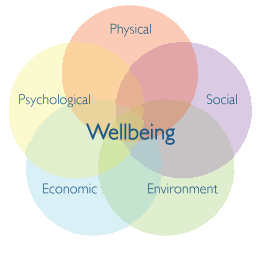
reflecting the holistic nature of Desert Spirituality -
the justice of the prophets;
the contemplative prayer of the Desert Fathers & Mothers;
the love of Jesus's Commandments;
and
the care of our Creator's design and work.
Back in 2007, I posted the words of a Morning Prayer of my own devising. I thought it time to bring it once more to the forefront on this Monday of Week 3 of Lent, 2014. ~~~~~
Thomas said to Him, “Lord, we do not know where You are going, and how can we know the way?” Jesus said to him, “I am the way, the truth, and the life. No one comes to the Father except through Me.
John 14:5,6
MORNING PRAYER
Lord Jesus Christ
You are The Way, The Truth and The Life.
You are The Way.
Guide me.
Plant my feet firmly in your path
That I may not deviate either to left or to right
But follow you closely:
Just an arm's length away that I might touch the hem of your garment:
Within earshot that I might hear your word and your will for my life.
Let us pray for peace of mind and healing of hearts,
wherever that is needed.
Let’s pray especially for those in our world who are feeling
lost or abandoned; homeless or isolated:
We can be with them
Let’s pray for those in the world who are suffering from
religious prejudice or violence;
For refugees and asylum seekers on Manus Island:
We can be with them
Let’s pray for the children of our world who lack
safekeeping, especially those orphaned because of natural and human disasters:
We can be with them
Let’s pray for all in our world in need of respect, safety,
dignity and justice:
We can be with them
Let’s pray for those in our world who are grieving...those
missing from the Malaysian Airlines tragedy and their families... who are
enduring physical or mental pain...who are facing or enduring losses:
We can be with them
Let’s pray for all the sick in our community...
We can be with them
Let’s pray for the peacemakers of our world, the healers and
the joyful ones, those who ease our lives and make them lighter, more glorious
and more meaningful:
We can be with them
Let’s pray for all those who will come into our world to-day
... and all those who will leave it:
We can be with them
Let’s pray for our own selves ... our families ... our
parishes ... our diocese ... our Bishop ... the small and large communities of
which we are part ... for our whole human family.
We can be with them
Finally, let’s pray for those spiritual guides, especially
Sheila Upjohn, and those teachers whose words, loving-kindness and example
allow us to find our way:
We can be with them
In Silence let’s offer the prayers of our hearts and minds ...
Further to previous posts here and here relating to the event at Saint Paul's Ballarat concerning Julian of Norwich featuring Sheila Upjohn who has written a number of books about Blessed Julia. Clicking on the picture below will take you to pictures of the event.
March 14 & 15 2014
St. Paul's Bakery Hill
5 Humffray Street South, Ballarat
August 1 & 2 2014
Christ Church Warrnambool
"Pray always and never lose heart" Luke 18:1
"We don't go to prayer to get something from God; we go to prayer to be like God." Cassian
"God is home, it's we who have gone for a walk." Meister Eckhart
Sheila Upjohn is the author of In Search of Julian of Norwich, All
Shall Be Well and Why Julian Now? She also translated the extracts from
Julian's book for the best-selling anthologies Enfolded In Love and In
Love Enclosed. Like Julian, Sheila Upjohn is a Norwich woman, and for
most of her life has lived in the city where Julian wrote her book. She
now lives in Australia and is delighted to share with us her knowledge
and enthusiasm for Julian.
Timetable
FRIDAY
5.30pm: Gathering, Introduction & Opening The Very Revd. Chris Chataway
6.00pm: Life of Prayer and Praying with the Saints Sheila Upjohn
This presentation provides an introduction to the weekend.
Participants
will be invited to reflect on their understanding of prayer, their own
life of prayer and the place it has in their lives. Prayer is
foundational to spiritual life and growth and at the same time it is
very personal. Each one of us needs to discover the forms of prayer
which are most helpful and to be faithful to a discipline of prayer. Our
preferred ways of praying will change during our life and the weekend
offers an opportunity for participants to explore new ways of praying
and to learn from holy men and women like Blessed Julian of Norwich. Her
messages of God's unqualified love for us are as true and needed today
as they were when she wrote them in the middle of the 14th century.
Taize
prayer is a contemplative style of prayer based on music and silence.
Created by the Taize community in France it has been found to be a very
attractive form of prayer for young people all over the world.
SATURDAY
10.00am: Arrival and Morning Tea
10.30am - 11.30am: Julian of Norwich Sheila Upjohn
11.30am - 12.10: Prayer workshops
Participants will be able to choose one of three workshops.
Workshop 1: Praying with Scriptures Rev'd Dr. Tim Gaden
The traditional form of prayer known as
Lectio Divina helps people to engage with the living word of Scripture.
It allows the person the opportunity to hear this word three times in
the voice of different people. The first time allows a person to water
the earth of their lives, the second time allows that water to sink deep
into the earth, and the third time recognises the small shoots that
start to push up through the earth seeking light. This method of prayer
allows a word or phrase to stay with you each day in a way which allows
you to recognise how God is working in your life.
"With gratitude in your hearts sing psalms and hymns and inspired songs to God" (Col 3:17).
Prayer is also about praise and joyful
expression of our love for God. Rev. Anne will help us explore
Charismatic prayer and its relevance for us today.
Workshop 3: Introduction to Christian Meditation Fr. Cliff Cheong
"Be still and know that I am God" (Ps 46:10)
12.15pm - 1.00pm: Holy Eucharist
1.10pm - 1.35pm: Lunch
1.45pm - 2.15pm: Prayer workshops
Participants will be able to choose one of three workshops.
Icons
are written (written, not painted, because they are the Word of God)
using traditional shapes and colours which help elucidate the
theological mystery presented in the image and also help the viewer to
be in a state conducive to prayer.
For
many years Fr George has witnessed to the healing power of Jesus Christ
through the celebration of the Healing Mass. He will share his
experiences with us and teach us more about faith in the healing power
of the Sacraments and the power of God's healing touch to bring
physical, mental, emotional and spiritual wholeness.
Workshop 3: Spiritual Direction/Accompaniment Fr. Graham Snell
An
introduction to the practice of spiritual accompaniment and direction,
its brief history and a look at how it can help us deepen our inner
lives and grow in our spiritual journey.
2.20pm - 2.45pm: Time to write one's own prayer
Followed by Feedback and Closing Prayer
RSVP / Enquiries:
spacb@bigpond.com
03 5332 6479
Cost:
If you would like to share the costs of running this weekend we suggest: $10 waged, $5 unwaged
but if you can't share the costs, please feel very welcome to come for free.
Last Sunday, Christian faith communities int he Western Tradition (the Eastern tradition operates on the Julian calendar, the Western on the Gregorian calendar) celebrated Candlemas.
Below is the beautiful music of the great Arvo Part celebrating the presentation of Jesus in The Temple. The words of the prayer 'Nunc dimittis' are uttered each day in The Prayer of The Church otherwise known as The Liturgy of The Hours.
Picture above is from here
Now, Master, you let your servant go in peace.
You have fulfilled your promise.
My own eyes have seen your salvation,
which you have prepared in the sight of all peoples.
The Lord's Prayer (Taoist Inspired Version by Matthew Fox)
O Mother of the Universe, Our Great Mother, the Tao,
You
dwell in nature, in the sky, and in the heavens.
Empty yet inexhaustible,
You give birth to infinite worlds
You flow through all things, inside and outside,
May you give birth through us.
Sacred is your unnameable name.
Open our hearts like the sky.
May each being in the universe
Return to the common source that is You and that is serenity.
Then, realizing where we come from,
Earth will be like heaven
and we will become naturally tolerant,
Disinterested, amused,
Kindhearted as a grandmother,
Dignified as a king.
May we, immersed in your order,
Deal with whatever life brings us
Knowing that when death comes, we
will be ready.
May we heed your teaching that violence,
Even when well intentioned,
Always rebounds upon itself.
May we learn that our enemies are not demons
But human beings like ourselves.
Help us to remain centred in you
So that all things will be in harmony.
Then the world would become a paradise.
All people would be at peace
And the law would be written in our hearts.
As we learn to accomplish the great task
By a series of small acts
May we be patient with friends and enemies,
Compassionate toward ourselves
In order to reconcile all beings in the world.
When the first Christians read – or more probably heard – the opening words of John's gospel, they would have understood straight away quite a lot more than we do. They would have remembered, many of them, that in Hebrew 'word' and 'thing' are the same, and they would all have known that in Greek the word used has a huge range of meaning – at the simplest level, just something said; but also a pattern, a rationale, as we might say, even the entire structure of the universe seen as something that makes sense to us, the structure that holds things together and makes it possible for us to think.
Against this background, we can get a glimpse of just what is being said about Jesus. His life is what God says and what God does; it is the life in which things hold together; it is because of the life that lives in him that we can think. Jesus is the place where all reality is focused, brought to a point. Here is where we can see as nowhere else what connects all reality – all human experience and all natural laws. Edward Elgar famously said about his Enigma Variations that they were all based on a tune that everyone knew – and no-one has ever worked out what he meant. But John's gospel declares that the almost infinite variety of the life we encounter is all variations on the theme that is stated in one single clear musical line, one melody, in the life of Jesus of Nazareth. 'In him was life, and the life was the light of men.'
But this shouldn't make us forget entirely the underlying image. The life that lives in Jesus, the everlasting divine agency that is uniquely embodied in him, is like something that is said – a word addressed to us. Because, like any word addressed to us, it demands a response. And the gospel goes on at once to tell us that the expected response was not forthcoming. Before we have even got to Christmas in the words of the gospel we are taken to Good Friday, and to the painful truth that the coming of Jesus splits the world into those who respond and those who don't. Once the word is spoken in the world, there is no way back. Your response to it, says the gospel again and again, is what shows who and what you really are, what is deepest in you, what means most. What we say or do in our response to Jesus is our way of discovering for ourselves and showing to one another what is real in and for us. Like the other gospel writers, John hints very strongly that some people respond deeply and truthfully to Jesus without fully knowing who he is or what exactly they are doing in responding to him; this is not a recipe for tight religious exclusivism.But the truth is still an uncompromising one: if you cannot or will not respond, you are walking away from reality into a realm of trackless fogbound falsehood.
There is the question we cannot ignore. It's been well said that the first question we hear in the Bible is not humanity's question to God but God's question to us, God walking in the cool of the evening in the Garden of Eden, looking for Adam and Eve who are trying to hide from him. 'Adam, where are you?' The life of Jesus is that question translated into an actual human life, into the conversations and encounters of a flesh and blood human being like all others – except that when people meet him they will say, like the woman who talks with him at the well of Samaria, 'Here is a man who told me everything I ever did.' Very near the heart of Christian faith and practice is this encounter with God's questions, 'who are you, where are you?' Are you on the side of the life that lives in Jesus, the life of grace and truth, of unstinting generosity and unsparing honesty, the only life that gives life to others? Or are you on your own side, on the side of disconnection, rivalry, the hoarding of gifts, the obsession with control? To answer that you're on the side of life doesn't mean for a moment that you can now relax into a fuzzy philosophy of 'life-affirming' comfort. On the contrary: it means you are willing to face everything within you that is cheap, fearful, untruthful and evasive, and let the light shine on it. Like Peter in the very last chapter of John's gospel, we can only say that we are trying to love the truth that is in Jesus, even as we acknowledge all we have done that is contrary to his spirit. And we say this because we trust that we are loved by this unfathomable mystery who comes to us in the shape of a newborn child, 'full of grace and truth'.
Finding words to respond to the Word made flesh is and has always been one of the most demanding things human beings can do. Don't believe for a moment that religious language is easier or vaguer than the rest of our language. It's more like the exact opposite: think of St John writing his gospel, crafting the slow, sometimes repetitive pace of a narrative that allows Jesus to change the perspective inch by inch as a conversation unfolds. Or of St Paul, losing his way in his sentences, floundering in metaphors as he struggles to find the words for something so new that there are no precedents for talking about it. Or any number of the great poets and contemplatives of the Christian centuries. It isn't surprising if we need other people's words a lot of the time; and it's of great importance that we have words to hand that have been used by others in lives that obviously have depth and integrity. That's where the language of our shared worship becomes so important.
This coming year we celebrate the 350th anniversary of the Book of Common Prayer. It has shaped the minds and hearts of millions; and it has done so partly because it has never been a book for individuals alone. It is common prayer, prayer that is shared. In its origins, it was meant to be – and we may well be startled by the ambition of this – a book that defined what a whole society said to God together. If the question 'where are you?' or 'who are you?' were being asked, not only individual citizens of Britain but the whole social order could have replied, 'Here we are, speaking together – to recognize our failures and our ideals, to recognize that the story of the Bible is our story, to ask together for strength to live and act together in faithfulness, fairness, pity and generosity.' If you thumb through the Prayer Book, you may be surprised at how much there is that takes for granted a very clear picture of how we behave with each other. Yes, of course, much of this language feels dated – we don't live in the unselfconscious world of social hierarchy that we meet here. But before we draw the easy and cynical conclusion that the Prayer Book is about social control by the ruling classes, we need to ponder the uncompromising way in which those same ruling classes are reminded of what their power is for, from the monarch downwards. And the almost forgotten words of the Long Exhortation in the Communion Service, telling people what questions they should ask themselves before coming to the Sacrament, show a keen critical awareness of the new economic order that, in the mid sixteenth century, was piling up assets of land and property in the hands of a smaller and smaller elite.
The Prayer Book is a treasury of words and phrases that are still for countless English-speaking people the nearest you can come to an adequate language for the mysteries of faith. It gives us words that say where and who we are before God: 'we have erred and strayed from thy ways like lost sheep', 'we are not worthy so much as to gather up the crumbs under thy table', but also, 'we are very members incorporate in the mystical body of thy Son, which is the blessed company of all faithful people; and are also heirs through hope of the everlasting kingdom'. It gives us words for God that hold on to the paradoxes we can't avoid: 'God... who art always more ready to hear than we to pray,' 'who declarest thy almighty power most chiefly in showing mercy and pity, 'whose property is always to have mercy.' A treasury of words for God – but also a source of vision for an entire society: 'Give us grace seriously to lay heart the great dangers we are in by our unhappy divisions'; 'If ye shall perceive your offences to be such as are not only against God but also against your neighbours; then ye shall reconcile yourselves unto them; being ready to make restitution'.
The world has changed, the very rhythms of our speech have changed, our society is irreversibly more plural, and we have – with varying degrees of reluctance – found other and usually less resonant ways of talking to God and identifying who we are in his presence. If we used only the Prayer Book these days we'd risk confusing the strangeness of the mysteries of faith with the strangeness of antique and lovely language. But we're much the poorer for forgetting it and pushing it to the margins as much as we often do in the Church. And it is crucial to remember the point about the Prayer Book as something for a whole society, binding together our obligations to God and to one another, in a dense interweaving of love and duty joyfully performed.
The Prayer Book was once the way our society found words to respond to the Word, to say who and where they were in answer to God's question. Those who prayed the Prayer Book, remember, included those who abolished the slave trade and put an end to child labour, because of what they had learned in this book and in their Bibles about the honour of God and of God's children. They knew their story; they knew how to give an answer for themselves, how to join up the muddle of their experience in a coherent pattern by relating it to the unchanging truth and grace of God. That's why the coming year's celebration is not about a museum piece.
The most pressing question we now face, we might well say, is who and where we are as a society. Bonds have been broken, trust abused and lost. Whether it is an urban rioter mindlessly burning down a small shop that serves his community, or a speculator turning his back on the question of who bears the ultimate cost for his acquisitive adventures in the virtual reality of today's financial world, the picture is of atoms spinning apart in the dark.
And into that dark the Word of God has entered, in love and judgment, and has not been overcome;
in the darkness the question sounds as clear as ever,
to each of us and to our church and our society: 'Britain, where are you?' Where are the words we can use to answer?
During Advent,
the Social Justice group has asked the people of All Saints to reflect on a
portion of Advent scripture in a context of Justice. The SJ group hopes this
reflection too assists in your studies and prayers in the week ahead.
Luke 1: 50-53
His mercy is for those who fear him
from generation to generation.
He has shown strength with his arm;
he has scattered the proud in the thoughts of their
hearts.
He has brought down the powerful from their thrones,
and lifted up the lowly;
he has filled the hungry with good things,
and sent the rich away empty.
Tucked away
in the Christmas story is Mary’s remarkable response, The Magnificat – My soul does magnify the Lord. Mary (the Jewish
version of her name is Miriam) echoes, with insight, another time and another
prophetic Miriam, the sister of Moses. Each woman intervened in the narrative
of Israel and the world by bringing into human history a child whose life would
be hallmarked with the spirit of redemption.
Mary knew
the character of the God who sent the messaging angel.She knew his mercy, his strength, his
diminution of the proud and powerful, his uplift of the humble and
powerless.Mary knew her God as a
provider and his disdain for those who relied on wealth and status.Her words are for us to-day. Her active
acceptance of what was being asked of her, personally, is also a model for us
to-day.
Mary’s view
of God was broad and deep. In the all-encompassing God was, and is to-day, a place
for herself.The God who deals with
nations and generations also takes into account the individual.It is so with God’s justice. God’s actions
are broad and deep: across nations, across generations, across the sweep of
history yet into the lives of individuals.
To-day,
when we feel the march of history close at hand in the lives of nations and
individuals, we know that God’s mercy, God’s justice is present too.