~~~~~~~~~
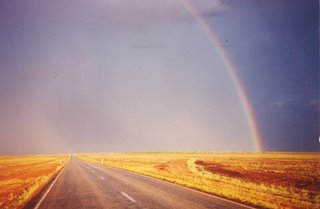
Rainbow on The Barkly
life is one of presence to the desert, presence to God.
For the desert is an empty and vast symbol of the unknowable God.
William Johnston in The Wounded Stag
The Barkly is a distinct region extending across the Queensland and Northern Territory border, not too far from the centre of Australia. While the region itself is distinct in geology, geography, and culture its boundaries are blurred, difficult to outline definitively.
One can enter upon The Barkly without knowing. There is no sign to provide direction or tell of arrival there. The one sign - sacrament even - is a highway, The Barkly Highway. It travels laterally through the region in a more or less straight line for not quite a thousand kilometres. It penetrates a land of legend yet travellers who are not familiar with the resource, cultural or historic richness of The Barkly feel they are in a barren and desolate land.
A traveller may unknowingly pass one of the greatest pastoral holdings in the world, through country traversed to this day by people of traditional and diverse language groupings without anything to draw attention to the fact. Occasionally, evidence of the region’s geological richness is seen in towns and mining superstructure.
On the NT side, The Barkly covers approximately 250,000 square kilometres with a population of approximately 6,000 people. People of the continental fringe ask “Why do you live there?” They have a picture of stagnation and boredom and isolation. They do not understand that life here is one of “presence to the desert, presence to God.” This is a place to be present to people and their cultures.
What does this “presence” mean? Our Australian interior is old country and it is palpably so. Come upon The Barkly just east of Cloncurry, Queensland. Travel through the Argyllas. To one whose spirit belongs in The Barkly, and who has travelled gradually from the urbanised coastal fringes of the continent, the spirit sings on arrival.
This is home. This is rest for the body, soul and spirit. Here is healing. To travel eastward from Mount Isa to Cloncurry, one has a vista of vast ages imposing the elements on a continually worn landscape.
Travel across the vast distances between Tennant Creek and the Queensland-Northern Territory border and one is conscious of humanity’s place in the scheme of things. Distance, vastness, isolation, and extremes of climate are overwhelming here. The traveller is not in a comfortable landscape. Here the landscape not only surrounds utterly, it penetrates one’s being.
There are no huge trees. There is abundant flora which does not grow tall. Much of it hugs the ground, staying close to make the most of what little moisture there may be and to present a low profile to the desert wind.
In making one’s life present to the desert, it is possible - as in all things - to see positive and negative results. For those whom the desert has adversely overwhelmed, the spirit may be left barren, parched, and cracked. Unable to give forth life.
For those who have allowed themselves to be open to the desert, who have absorbed its beauty as well as its harshness, there is abundant life. The secret waterfilled places are known. The rich lodes of quartz hanging on tightly to precious gold are treasured in deep places. There is food from the grassland and language and culture to allow expression, celebration and remembrance.
The Barkly appears flat and unchanging but there are the high places. The patriarchal literature of the Old Testament tells of the worship of El Shaddai on the high places. These are places of vista. In The Barkly, suddenly, one may find oneself alone gazing out across the vastness from stunning vantage.
There is a place when travelling east on The Barkly Highway near Alexandria where suddenly there is the realisation of a high place. I once came to this place in the early evening of a long summer twilight. A 240 degree vista of golden grassed plain was before me. Above it hung a heavy storm-grey sky filled with lightning dancing from horizon to horizon: a timeless theatrical performance from the drama of eternity.
When I travel north from Tennant, the road to Renner Springs provides high places to lift my spirit and cause it to rejoice. I look across expanses of countryside without a sign of anything that has to do with a human being. It is truly wilderness without habitation.
Presence to the desert, presence to God? The former permits the latter. Being present to the desert takes one from a zone of comfort. It shatters and remoulds preconceived ideas. It relies on the experiential not the idyllic nor the theoretical. It calls forth the tangible into the spiritual and allows the spiritual to inform earthly reality. It means exposure to elemental force. It becomes an incarnation of spirit and matter as real as the Christian theology of God became Man and dwelt among us.
To place one’s self in the desert is to place one’s self in the presence of God. It is stepping into the place of vulnerability. No longer the doer but the done to. No longer the knower but the seeker. No longer the lover but the loved. No longer owning but sharing. From here, the place of spirit’s rest, becomes the place of spirit’s growth.
One can enter upon The Barkly without knowing. There is no sign to provide direction or tell of arrival there. The one sign - sacrament even - is a highway, The Barkly Highway. It travels laterally through the region in a more or less straight line for not quite a thousand kilometres. It penetrates a land of legend yet travellers who are not familiar with the resource, cultural or historic richness of The Barkly feel they are in a barren and desolate land.
A traveller may unknowingly pass one of the greatest pastoral holdings in the world, through country traversed to this day by people of traditional and diverse language groupings without anything to draw attention to the fact. Occasionally, evidence of the region’s geological richness is seen in towns and mining superstructure.
On the NT side, The Barkly covers approximately 250,000 square kilometres with a population of approximately 6,000 people. People of the continental fringe ask “Why do you live there?” They have a picture of stagnation and boredom and isolation. They do not understand that life here is one of “presence to the desert, presence to God.” This is a place to be present to people and their cultures.
What does this “presence” mean? Our Australian interior is old country and it is palpably so. Come upon The Barkly just east of Cloncurry, Queensland. Travel through the Argyllas. To one whose spirit belongs in The Barkly, and who has travelled gradually from the urbanised coastal fringes of the continent, the spirit sings on arrival.
This is home. This is rest for the body, soul and spirit. Here is healing. To travel eastward from Mount Isa to Cloncurry, one has a vista of vast ages imposing the elements on a continually worn landscape.
Travel across the vast distances between Tennant Creek and the Queensland-Northern Territory border and one is conscious of humanity’s place in the scheme of things. Distance, vastness, isolation, and extremes of climate are overwhelming here. The traveller is not in a comfortable landscape. Here the landscape not only surrounds utterly, it penetrates one’s being.
There are no huge trees. There is abundant flora which does not grow tall. Much of it hugs the ground, staying close to make the most of what little moisture there may be and to present a low profile to the desert wind.
In making one’s life present to the desert, it is possible - as in all things - to see positive and negative results. For those whom the desert has adversely overwhelmed, the spirit may be left barren, parched, and cracked. Unable to give forth life.
For those who have allowed themselves to be open to the desert, who have absorbed its beauty as well as its harshness, there is abundant life. The secret waterfilled places are known. The rich lodes of quartz hanging on tightly to precious gold are treasured in deep places. There is food from the grassland and language and culture to allow expression, celebration and remembrance.
The Barkly appears flat and unchanging but there are the high places. The patriarchal literature of the Old Testament tells of the worship of El Shaddai on the high places. These are places of vista. In The Barkly, suddenly, one may find oneself alone gazing out across the vastness from stunning vantage.
There is a place when travelling east on The Barkly Highway near Alexandria where suddenly there is the realisation of a high place. I once came to this place in the early evening of a long summer twilight. A 240 degree vista of golden grassed plain was before me. Above it hung a heavy storm-grey sky filled with lightning dancing from horizon to horizon: a timeless theatrical performance from the drama of eternity.
When I travel north from Tennant, the road to Renner Springs provides high places to lift my spirit and cause it to rejoice. I look across expanses of countryside without a sign of anything that has to do with a human being. It is truly wilderness without habitation.
Presence to the desert, presence to God? The former permits the latter. Being present to the desert takes one from a zone of comfort. It shatters and remoulds preconceived ideas. It relies on the experiential not the idyllic nor the theoretical. It calls forth the tangible into the spiritual and allows the spiritual to inform earthly reality. It means exposure to elemental force. It becomes an incarnation of spirit and matter as real as the Christian theology of God became Man and dwelt among us.
To place one’s self in the desert is to place one’s self in the presence of God. It is stepping into the place of vulnerability. No longer the doer but the done to. No longer the knower but the seeker. No longer the lover but the loved. No longer owning but sharing. From here, the place of spirit’s rest, becomes the place of spirit’s growth.
© Brigid O’Carroll Walsh 2000