Occupy Faith

Occupy Faith
Click thru to site

LECTIONARY

LECTIONARY
Click thru to site
Showing posts with label Children. Show all posts

Tuesday, December 27, 2011

Children bearing the cost of politics and war: the Holy Innocents and a Peace Procession

Amplify

Many Christians think that Jesus did not enter into the political fray. No disparaging name-calling for him.  I can't stand the "Gentle Jesus meek and mild" version of Christianity, particularly as portrayed in modern forms as a gentle-faced, fairish blue-eyed Jesus. The scriptures might say He was meek - but do we understand what that word means to-day?  And Jesus was certainly far from mild.  In Luke 13:32, Jesus refers to the then reigning member of the Herods as a fox.   I wonder where that view, that description came from? 
I think of a family living in Nazareth.  Like all families there are stories and "remember whens".  How huge a thing in the life of the Ben David family it must have been when Joseph and Mary, warned by an angel, fled with their young son into Egypt to escape the massacre of young children by Herod the Great (Matthew 2:13).  There they remained until there was a change in political leadership from Herod the Great to his son, Archelaus.  

When the Ben David family returned from Egypt they did not go back to Bethlehem but to Nazareth.  Even if the boy Jesus had no memory of his own regarding these events, he would have been immersed in his family's history and story.  How could a family have retold this story without making political comment or passing on a view of those who instigated their refugee status?  

The Herod Jesus refers to in Luke is another son of Herod the Great, Antipas: Tetrarch of Galilee and Perea; political opportunist and collaborator under Roman rule in Judaea.  Surely, Herod Antipas was a fox indeed: sly, wily, treading warily through the pitfalls and pratfalls of Roman rule.  Would the Herods have kept alive the story of the massacre of the little children? I think not.  But the Ben David family did. Only by divine intervention did they save a very precious son.

To-morrow, 28 December,  the Massacre of the Holy Innocents is remembered.  The children who died because of the bloodlust and envy of a powerful and wily king have never been forgotten by the Christian church.  
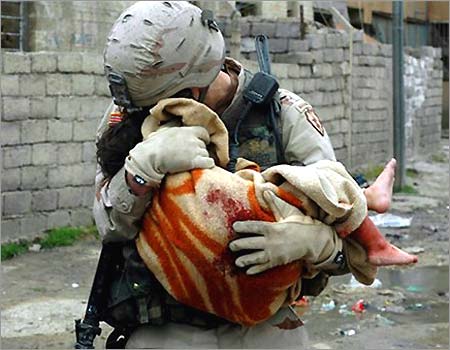
To-morrow in Melbourne, the remembrance will take a contemporary turn:  

Wednesday 28 December, 10 am – 11.30 am: Feast of Holy Innocents Peace Procession 
In the days after Christmas, while most people are recovering from the indulgence of Christmas Day or deeply immersed in the liturgy of the Boxing Day Test, the Church calendar commemorates the Holy Innocents, the children killed by Herod in a bid to maintain his power and privilege. This is a part of the Christmas story which gets little attention in churches, yet it forms a major part of the biblical birth narrative. It is a day when we remember children and other innocent people killed by today’s Herods, who consider such innocents to be acceptable collateral damage in their quest for power and security. Children are still the most deeply affected by wars around the globe – 65% of Afghans are under the age of 18. 90% of those killed in wars are civilians. Join us for a peace procession from Victoria Barracks in Melbourne to Defence Plaza. We will begin at 10 am with prayers at Victoria Barracks on St Kilda Road, and process to Defence Plaza, 661 Bourke St. Melbourne, for further prayer and reflection.
Children of war: fight, dying, surviving 

"The source of most human violence and suffering has been a hidden children's holocaust throughout history, whereby billions of innocent human beings have been routinely murdered, bound, starved, raped, mutilated, battered and tortured by their parents and other caregivers, so that they grow up as emotionally crippled adults and become vengeful time bombs who periodically restage their early traumas in sacrificial rites called wars."
- Lloyd DeMause
Hat Tip to Iain Macadair

Photobucket

Wednesday, May 23, 2007

The Journey from '67: My mother told me a story

Mothers waiting for their children by Hazel Mackinnon
Stolen by Hazel MacKinnon

My Mother Told Me A Story

Many years ago my mother told me a story
a story about when she was a child
and it goes like this:
it was a cool sunny day
and all the coloured kids
were playing around in their way.
But coming in the distance my grandmother saw
white people
coming towards the station.

My mother told me this story
a story about when she was a child
growing up on the station -
my mother told me this story.
Some of the mothers started to run
and hide with their kids
down towards the waterhole in the bush -
but they took every half-caste kid in sight.
But my grandmother hid my mother
in an empty hay-sack bag.

My grandmother waited for the whites to go
but it was sadness that day
for the mothers of that land
'cause their children were taken away
from their dreaming and their culture.
This story makes me sad -
what my mother told me.
by Michael Fitz Jagamarra
published in
Voices from the Heart:
contemporary Aboriginal poetry from Central Australia
collected and edited by Roger Bennett
and published by
IAD Press, Alice Springs

Wednesday, April 04, 2007

A penny and God: a memory for life

Your correspondent, dear Reader, awoke early this morning thinking of the Penny Catechism. The Penny Catechism (so-called because it originally cost a penny and its price used to go up by one penny) is famous in the English speaking world as the little book which taught generations of Catholic children, in rote question and answer form, the rudiments of their faith. Miss Eagle was raised in the pre-Vatican II Australian Irish-Catholic tradition by the Sisters of Mercy, mostly Irish, in a parish staffed by Capuchin priests, mostly Italian-Americans. From a search of the net it appears that the Penny Catechism was not exactly the same everywhere. There were variations. Miss E is unable to find a text of the Australian version on the net - only reference to it.

Miss E often thinks on the first and second question in the Catechism:
1. Q. Who made you?
A. God made me.
2. Q. Why did God make you?
A. God made me to know Him, love Him and serve Him on this earth, and be happy with Him forever in Heaven.

The way children were taught their catechism in those days, some would call it indoctrination. Perhaps. But while there has been much to doubt, challenge, and reject about Catholicism itself, there has never, in Miss Eagle's mind and spirit, been any doubt about these two fundamental issues. She started school at four and half years of age and is seven weeks away from the old-age pension but these two simple questions with their only slightly less simple answers have guided her life. They are pole stars, a blessed assurance.

But it was not this portion of the Penny Catechism that came to mind when Miss E's eyelids sprung open this morning. It was this:
Why do we call that day good on which Jesus Christ died?
We call that day good on which Jesus Christ died because, by his death on the Cross, he did redeem the world.

If anyone thinks that Miss E's memory is not correct (remember this is the Australian version not the U.S. or English version), could you please advise your correction. If you have a copy of the Australian version of the Penny Catechism ( for U.S. versions see here), would you mind scanning it and sending a digital copy to Miss Eagle at the email address on the sidebar, please? It would be greatly appreciated.