Occupy Faith

Occupy Faith
Click thru to site

LECTIONARY

LECTIONARY
Click thru to site
Showing posts with label Seasons of the Soul. Show all posts

Wednesday, March 06, 2013

Seasons - of life, of body, of soul, of spirit.

Amplify


How important are the Seasons and how important it is to be aware of them.  

Within our spiritual walk, we greet the seasons.  However, for those of us living in the Southern Hemisphere, it can be very difficult to draw every bit of spiritual juice from a season when its heritage is located firmly and historically in the Northern Hemisphere.  In fact, some of my favourite feasts could benefit from a rethinking in a southern or country specific context.

As well as the spiritual calendar, we have the dominant calendar.  This can be regarded as scientific or as a legacy of a dominant European empire.  

Then, as many of us know, but not all of us realise there are the indigenous, place specific seasons.  

The picture above relates to The Gooniyandi Seasons Calendar.  Please follow the link to find out more.

It should be emphasised that this calendar relates to a specific place or country.  This cannot be applied in every part of Australia - or even every part of tropical Australia.  I think those of us who are gardeners, particularly those who garden for food, realise that even suburb to suburb a few kilometres apart in a city can have different micro-climates.  When frost ceases, when winds come, when vegetables mature. 

As we draw close to the awareness and practicum of the seasons, we are enabled and encouraged to draw closer to our Creator, the Designer of our world.  We can partner with this aspect of Creation to our own benefit.  Let us learn from our Creator, from the original inhabitants, let us listen to the experience of the old hands. 

As much of the world evidences changes in established climate patterns, we still need to learn from the past as new avenues of learning come upon us.  Isn't that like our spiritual journey? We learn, we change, we learn again. Through this we expand our knowledge of ourselves and others.  We learn more of the Creator we worship and the personality who designed all this with us - and other species - in mind.  We experience the seasons of our lives.


Photobucket

Tuesday, January 17, 2012

Fasts and Feasts: sustainability and a Lenten lifestyle

Amplify


On 22 February 2012 -   the season of Lent leading up to Good Friday and Easter will begin with Ash Wednesday.  In the Western Christian tradition, fast days are Ash Wednesday and all Fridays.  Some add Wednesdays as an option.  Ash Wednesday and Fridays, are also abstinence days when there is abstinence from meat.  On these days Christians have fish and vegetarian dishes.

I am posting as a reminder that, in the season when Christian seafood eating is dominant, we might consider seafood sustainability and the health and welfare of oceans, rivers and watercourses from which seafood comes.  Not only can we consider these matters during the Lenten season.  We should be seeking to embed such ideas in our lifestyles as permanent patterns.  For more on this, please go to my food blog, Oz Tucker.


Photobucket

Wednesday, December 28, 2011

The Gate of the Year

Amplify
This post was originally published on The Trad Pad on  2 January 2011.  Happy New Year everyone ... particularly to those who did it tough this year.  Please take on board the thoughts of Minnie Louise Haskins
~~~~~~

Happy New Year! May the year be kind to you and bring you blessings, wisdom, peace, and prosperity!  The last day or two has exhibited some coincidence. Firstly, Hay Quaker published, in toto, the poem The Gate of the Year by Minnie Louise Haskins.
Minnie Louise Haskings - The gate of the year
 Minnie Louise Haskins
I said to the man who stood at the gate of the year,
"Give me a light that I may tread safely into the unknown."
And he replied, "Go into the darkness and put your hand into the hand of God.
That shall be to you better than light and safer than a known way!"
So I went forth and finding the Hand of God
Trod gladly into the night.
He led me towards the hills
And the breaking of day in the lone east.
So heart be still!
What need our human life to know
If God hath comprehension?
In all the dizzy strife of things
Both high and low,
God hideth his intention.
Perhaps readers have heard this poem, or part of it, before.  It was made famous by the Christmas Speech of King George VI delivered in 1939.  You can hear the actual speech – it is quite moving given it is made at the time of the first Christmas of World War II – here.
the-kings-speech -the movie
Secondly, I decided to get out of the house for the first time since  Christmas Midnight Carols and Eucharist at All Saints, Mitcham and go to see the much lauded movie, The King’s Speech. It is the story of the relationship between the Australian speech therapist, Lionel Logue, and King George VI.


The movie is being tipped as a frontline contender for an Oscar. In spite of competition from The Social Network in the bookies’ odds as set out here, it is hard to see how this movie could lose with its high proportion of former Academy Award winning actors.  The UK still produces the best actors – particularly in ensemble work as demonstrated in The King’s Speech – in the English speaking world.  However, it does an Australian heart good – particularly one coming from Queensland – to see and hear Geoffrey Rush mixing it admirably with such a talented cast. To think, this great man of Australian movies was growing up across Brisbane from me in the 1950s!
Those sitting around me in the packed movie theatre were clearly as impressed as I. 
I was however surprised at the ending. I don’t think, in such an historical movie, it is giving away much to describe the ending of this movie.  I thought the movie somehow would finish with the 1939 Christmas Speech. This is arguably the most famous, most remembered, and most quoted of all the King George VI’s speeches.  This doesn’t happen.  The movie concludes with the King’s Speech at the beginning of World War II.
Photobucket

Tuesday, December 27, 2011

Children bearing the cost of politics and war: the Holy Innocents and a Peace Procession

Amplify

Many Christians think that Jesus did not enter into the political fray. No disparaging name-calling for him.  I can't stand the "Gentle Jesus meek and mild" version of Christianity, particularly as portrayed in modern forms as a gentle-faced, fairish blue-eyed Jesus. The scriptures might say He was meek - but do we understand what that word means to-day?  And Jesus was certainly far from mild.  In Luke 13:32, Jesus refers to the then reigning member of the Herods as a fox.   I wonder where that view, that description came from? 
I think of a family living in Nazareth.  Like all families there are stories and "remember whens".  How huge a thing in the life of the Ben David family it must have been when Joseph and Mary, warned by an angel, fled with their young son into Egypt to escape the massacre of young children by Herod the Great (Matthew 2:13).  There they remained until there was a change in political leadership from Herod the Great to his son, Archelaus.  

When the Ben David family returned from Egypt they did not go back to Bethlehem but to Nazareth.  Even if the boy Jesus had no memory of his own regarding these events, he would have been immersed in his family's history and story.  How could a family have retold this story without making political comment or passing on a view of those who instigated their refugee status?  

The Herod Jesus refers to in Luke is another son of Herod the Great, Antipas: Tetrarch of Galilee and Perea; political opportunist and collaborator under Roman rule in Judaea.  Surely, Herod Antipas was a fox indeed: sly, wily, treading warily through the pitfalls and pratfalls of Roman rule.  Would the Herods have kept alive the story of the massacre of the little children? I think not.  But the Ben David family did. Only by divine intervention did they save a very precious son.

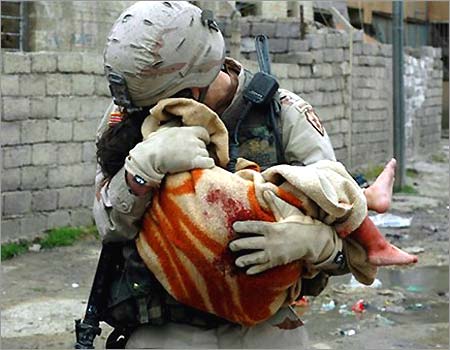
To-morrow, 28 December,  the Massacre of the Holy Innocents is remembered.  The children who died because of the bloodlust and envy of a powerful and wily king have never been forgotten by the Christian church.  
To-morrow in Melbourne, the remembrance will take a contemporary turn:  

Wednesday 28 December, 10 am – 11.30 am: Feast of Holy Innocents Peace Procession 
In the days after Christmas, while most people are recovering from the indulgence of Christmas Day or deeply immersed in the liturgy of the Boxing Day Test, the Church calendar commemorates the Holy Innocents, the children killed by Herod in a bid to maintain his power and privilege. This is a part of the Christmas story which gets little attention in churches, yet it forms a major part of the biblical birth narrative. It is a day when we remember children and other innocent people killed by today’s Herods, who consider such innocents to be acceptable collateral damage in their quest for power and security. Children are still the most deeply affected by wars around the globe – 65% of Afghans are under the age of 18. 90% of those killed in wars are civilians. Join us for a peace procession from Victoria Barracks in Melbourne to Defence Plaza. We will begin at 10 am with prayers at Victoria Barracks on St Kilda Road, and process to Defence Plaza, 661 Bourke St. Melbourne, for further prayer and reflection.
Children of war: fight, dying, surviving 

"The source of most human violence and suffering has been a hidden children's holocaust throughout history, whereby billions of innocent human beings have been routinely murdered, bound, starved, raped, mutilated, battered and tortured by their parents and other caregivers, so that they grow up as emotionally crippled adults and become vengeful time bombs who periodically restage their early traumas in sacrificial rites called wars."
- Lloyd DeMause
Hat Tip to Iain Macadair

Photobucket

Tuesday, November 29, 2011

Advent: liturgical, personal, a reality of life at various points in life

Amplify


This post is printed in full from Interrupting the Silence 
with kind permission of its author, Father Michael Marsh,
and gratitude from Miss Eagle.

“In Those Days….” – A Sermon on Mark 13:24-37, Advent 1B

by marshmk
The collect and readings for the First Sunday in Advent, Year B, may be found here. The following sermon focuses on Mark 13:24-37.
“In those days….” So begins our entry into the Season of Advent. It sounds ominous and it is. Advent is not just a liturgical season of the church year. It is a reality of life. It happens in all sorts of ways. It comes at various points in life, not just the four or five weeks before Christmas.
"In those days … the sun will be darkened, and the moon will not give its light, and the stars will be falling from heaven, and the powers in the heavens will be shaken.” These are Jesus words to his disciples. The disciples have been admiring the temple and the large stones. They are impressed. Jesus, however, is telling them that change is coming. The temple of their life is coming down.
If you have ever experienced significant change in your life, whether desired or dreaded, you know about “those days.” You know about Advent. You know what it is like to enter the darkness of change. All change, whether welcome or unwanted, brings some kind of loss. It may be the loss of a relationship, the loss of a loved one, the loss of what is comfortable, familiar, safe. Regardless, the world as we have known it has ended.
The Advents of our lives set before us important questions. How will we find our way forward when the usual lights that illumined our path no longer shine? What do we do when it feels as if our world is falling apart? Where do we go when it seems as if darkness is our only companion and God is no where to be seen?
The dark times of life are threshold moments. The temptation is to do something; to fix it, to ease the pain, to escape the uncertainly, and to get back to what used to be. The God of Advent does not allow that. We can never go back to the way it was before the lights went out. God does not undo our life. God redeems our life. Advent is not so much about the losses as it is about the hope and coming of what will be. That hope and coming is the Son of Man, Jesus the Christ. The presence of Christ is the ultimate answer to every prayer, to every light extinguishing loss, to every Advent of our life.
Every time we tell the Advent story of our life we echo the prophet Isaiah’s cry, “O that you would tear open the heavens and come down” (Is. 64:1 ). And God does. God is faithful. God strengthens us to the end. In the midst of our losses we lack nothing as we await the revealing of Lord Jesus Christ. (1 Cor. 1:7-9).
The Advent times of life are times of waiting. They are liminal times. In Advent we live in between what was and what will be. We are neither here nor there. We are betwixt and between. They are times of transition and it is hard, sometimes even impossible, to see the way forward.
If we allow them to the dark threshold places of life can draw us deeper into the divine mystery. They remind us that we do not know everything. We do not see all possibilities. We can neither predict nor control anything. We are not in charge. Advent challenges us to give up our usual sources of illumination, to let go of our habitual ways of knowing, and to question our typical ways of seeing. Advent invites us to receive the God who comes to us in the darkness of life.
At some point our world falls apart, life changes, or the lights go out. More often than not we see this as the end. When these things happen, Jesus says, remember the fig tree. Read the signs correctly. When its branch becomes tender and it puts forth leaves you know summer is near. So also when the darkness overtakes your life know that the Son of Man is near. Christ’s presence, our healing, and salvation, are always taking place in the dark and messy parts of life. We have not and never will be abandoned to the darkness.
“Be alert,” Jesus warns. He commands us to “Keep awake.” Darkness is not our enemy as much as is falling asleep. We fall asleep whenever fear controls or life, when hope gives way to despair, when busyness is equated with goodness, when entitlement replaces thanksgiving, when we choose what is comfortable rather than life-giving. Whenever we think our life is over, that darkness is our final reality, that we have been abandoned, or that loss and darkness are our only reality then we have fallen asleep.
To often we allow the darkness to deceive us into believing there is nothing worth waiting or watching for. So we close our eyes. We fall asleep and we become part of the darkness. We refuse to see the One who is always coming to us. The danger in the darkness is that we do not give out eyes time to adjust. We do not trust our night vision. Night vision is not about the light around us but the light that is within us, a light that can never be extinguished.
The Advents of our lives ask us to trust the Coming One more than the darkness. It means we must sit, listen, wait, watch. That is contrary to what most of the world believes and what our society rewards. We must show up every moment of our lives not just in spite of but because of the darkness. To show up and be present in the darkness of life is some of the hardest work we will ever do. Run from our darkness and we run from God.
In the darkness of Advent we move slower, we listen more than we speak, we hold questions rather than answers. We wait expectantly but without specific expectations. Waiting in darkness is an act of faithfulness and surrender to the Coming One. Waiting becomes our prayer, a prayer that is and will be answered by God’s presence.
Tell your Advent story; a story of change, loss, darkness. Then sit down. Be still. Be quiet. Listen. Wait. Watch. These are the practices of Advent. Why? Because God “works for those who wait for him” (Is. 64:4).

Photobucket