Occupy Faith

Occupy Faith
Click thru to site

LECTIONARY

LECTIONARY
Click thru to site

Wednesday, March 05, 2014

Ash Wednesday: a remembrance of who we really are and a prayer of repentance


There are two services at Saint Paul's, Humffray Street, Ballarat to-day for Ash Wednesday. I went to the 12 noon one and the next one is at 7pm.  My forehead is well-crossed with the ashes which are made by burning the crosses which are returned by parishioners from last year's palm crosses which mark Palm Sunday.

On Ash Wednesday, we are called not only to repentance.  We are called to remember, to be self-aware. 

If you wish to mark this special day in a brief and simple manner, below is a short Litany of Penitence.  The words are important - but more important is the spirit which is behind the individual's saying of the words.  This is heart and mind and spirit stuff that can change your life and how you live it.

A Litany of Penitence
Eternal God, maker of heaven and earth
Have mercy on us.Incarnate Word, redeemer of the world,
Have mercy on us.Abiding Spirit, give of light and life,
Have mercy on us.For turning away from y our presence,
For disobeying your word and commandments,
Forgive us, Lord.For trusting in our own strength instead of yours,
For betraying your trust and the trust of others,
Forgive us, Lord.For resisting your grace and refusing your blessings,
For holding back from proclaiming our faith in you,
Forgive us, Lord.For damaging this earth and exploiting its creatures,
For neglecting and wasting the gifts you have give us,
Forgive us, Lord.
For failing to forgive as we have been forgiven,
For judging others and bearing grudges,
Forgive us Lord.For skimping on our commitments and relationships,
For failing in hospitality,
Forgive us, Lord.For tolerating oppression, injustice, and wrong,
For keeping silent when we should have spoken up,
Forgive us, Lord.For turning away when others have offered us love,
For closing our hearts when others have needed compassion,
Forgive us, Lord.For all we have done unkindly, unjustly and dishonestly,
For our careless speech and hurtful words,
Forgive us Lord.

Photobucket

Ash Wednesday 2014 - a reflective time - Jonathan Rundman sings "Ashes", William Loader gives us "A Prayer for Ash Wednesday"


A Prayer for Ash Wednesday
The darkness asks us questions.
You are out there and we do not see.
You invite us into the night,
the stillness, the loneliness, the desert place.
We cannot see our shadow;
the cold damp of unknowing rises up from beneath our feet.
We tread cautiously, tentatively.
We are afraid,
afraid of ghosts
haunting us with spectres of guilt
and shame.
We would like to run back,
reach the river bank,
swim the Jordan,
sit in the sun by the sea,
mending our nets.
But you have brought us here
- with no bread.
When we look we can see only ourselves,
our darkness.
When we read,
it is invisible words which cannot be grasped,
thoughts we cannot clutch,
hope we cannot capture.
Yet the wild honey remains a taste in our mouth,
a memory for a new day.
Why have you brought us here?
What miracle will you perform for us?
The darkness sighs around us,
dense with your unseen presence,
close to our breathing,
close to our breathing.
O darkness, enlighten us,
embrace us with your invisible love.
Let us see your glory in the ashes.
Take us by the hand that we may trust the darkness.
Minister to us by your Spirit that we may not be afraid.
Jesus, keep the beasts away.
Amen

Photobucket

Tuesday, March 04, 2014

2014 Shrove Tuesday

To-night we will gather to-night at The Parish Centre, St Paul's, Humffray Street, Ballarat for our annual dose of pancakes - Pancake Day or Shrove Tuesday.

To-morrow is Ash Wednesday and so continues a mindful forty days until we celebrate the Risen Christ.

On 4 March 2012, the Second Sunday in Lent, the Revd Katherine Hedderly preached at St Martin in the Fields on Sacred Space.  Below is some of what she had to say and the whole may be found here.
But what does it mean to let Jesus live in us? Perhaps this journey of Lent is about allowing God to show us – show us where we need to de-clutter our lives, make space, enlarge our hearts and deepen our understanding – so that we can flourish in the bigger picture of his love – offered to us in the sacred space of Jesus’ life and death and resurrection.

Etty Hillesum, a young Jewish woman, whose inspiring and hope filled diary and letters, written during the holocaust years before her death in Auschwitz in 1943, that we are using as inspiration for our Lent Course this year, wrote of this sacred God-filled space within, at a time when she was surrounded by the worst human suffering and evil:

‘There is a deep well inside me. And in it dwells God. Sometimes I am there too. But more often stones and grit block the well and God is buried underneath. Then he must be dug out again.’


Picture at left from this site
Photobucket

Tuesday, February 04, 2014

Candlemas : The Liturgy of the Hours : Nunc Dimittis

Last Sunday, Christian faith communities int he Western Tradition (the Eastern tradition operates on the Julian calendar, the Western on the Gregorian calendar) celebrated Candlemas.

Below is the beautiful music of the great Arvo Part  celebrating the presentation of Jesus in The Temple. The words of the prayer 'Nunc dimittis' are uttered each day in The Prayer of The Church otherwise known as The Liturgy of The Hours.


Picture above is from here
Now, Master, you let your servant go in peace.
  You have fulfilled your promise.
My own eyes have seen your salvation,
  which you have prepared in the sight of all peoples.
A light to bring the Gentiles from darkness;
  the glory of your people Israel.
The Song of Simeon
The Gospel of Luke : Chapter 2 Verses 29-32

Over at Interrupting the Silence, Father Mike Marsh has included in his post for this feast, 
Arvo Part's wonderful Nunc Dimittis performed by The Tallis Scholars.


Photobucket

Saturday, January 04, 2014

The Epiphany - celebrating the first coming - the 12th night of Christmas


This post has come from the blog of Father Michael Marsh.   
Father Michael blogs at Interrupting The Silence. It is a great favourite of mine.


Epiphany Proclamation 2014


The Church has a couple of traditions related to The Feast of the Epiphany. One of those is The Epiphany Proclamation (another being the blessing of homes). During the liturgy on the Feast of the Epiphany, January 6, the Church proclaims the date of Easter as well as other feast and fast dates. The Proclamation announces more than dates. It proclaims the reality that our lives are to be lived in rhythm with and according to Jesus’ life. Here is the proclamation for this liturgical year:
Epiphany Proclamation 2014
Dear brothers and sisters, the glory of the Lord has shone upon us, and shall ever be manifest among us, until the day of His return.
Through the rhythms of times and seasons let us celebrate the mysteries of salvation.
Let us recall the year’s culmination, the Easter Triduum of the Lord: His Last Supper, His Crucifixion and Death, His Burial, and His Rising, celebrated between the evening of the 17th day of April and the evening of the 19th day of April, Easter Sunday being on the 20th day of April.
Each Easter—as on each Sunday—the Holy Church makes present the great and saving deed by which Christ has forever conquered sin and death. From Easter are reckoned all the days we keep holy.
Ash Wednesday, the beginning of Lent, will occur on the 5th day of March.
The Ascension of the Lord will be commemorated on the 29th day of May.
Pentecost, the joyful conclusion of the season of Easter, will be celebrated on the 8th day of June.
And this year the First Sunday of Advent will be on the 30th day of November.
Likewise the pilgrim Church proclaims the Passover of Christ in the feasts of the holy Mother of God, in the feasts of the Apostles and Saints, and in the commemoration of the faithful departed.
To Jesus Christ, who was, who is, and who is to come, Lord of time and history, be endless praise, for ever and ever. Amen.
Father Michael has also written about another tradition of the Epiphany here.  Ephiphany is the 12th day of Christmas and commemorates the coming of The Wise men.  In 2014, the official date of Epiphany is January 6 - but, mostly, it will be celebrated this Sunday January 5.  
Icon of the Adoration of the Magi (source)
Icon of the Adoration of the Magi (source

Photobucket

Sunday, March 17, 2013

Remembering and honouring Saint Patrick


Words: Ce­cil F. Al­ex­an­der, 1889.
Music: St. Pat­rick (Stan­ford), CharlesV. Stan­ford, 1902

The lyr­ics are a trans­la­tion of a Gael­ic po­em called “St. Pat­rick’s Lor­i­ca,” or breast­plate. (A “lorica” was a mys­tic­al gar­ment that was sup­posed to pro­tect the wear­er from dan­ger and ill­ness, and guar­an­tee ent­ry in­to Hea­ven.) Ce­cil Alex­an­der penned these words at the re­quest of H. H. Dick­in­son, Dean of the Cha­pel Roy­al at Dub­lin Cas­tle:
I wrote to her sug­gest­ing that she should fill a gap in our Irish Church Hymn­al by giv­ing us a me­tric­al ver­sion of St. Patrick’s “Lor­i­ca” and I sent her a care­ful­ly col­lat­ed co­py of the best prose trans­la­tions of it. With­in a week she sent me that ex­qui­site­ly beau­ti­ful as well as faith­ful ver­sion which ap­pears in the ap­pend­ix to our Church Hymn­al.
This hymn can be a chall­enge to sing with­out see­ing the words matched to the notes, but it is a mas­ter­piece ne­ver­the­less.

I bind unto myself today
The strong Name of the Trinity,
By invocation of the same
The Three in One and One in Three.

I bind this today to me forever
By power of faith, Christ’s incarnation;
His baptism in Jordan river,
His death on Cross for my salvation;
His bursting from the spicèd tomb,
His riding up the heavenly way,
His coming at the day of doom
I bind unto myself today.

I bind unto myself the power
Of the great love of cherubim;
The sweet ‘Well done’ in judgment hour,
The service of the seraphim,
Confessors’ faith, Apostles’ word,
The Patriarchs’ prayers, the prophets’ scrolls,
All good deeds done unto the Lord
And purity of virgin souls.

I bind unto myself today
The virtues of the star lit heaven,
The glorious sun’s life giving ray,
The whiteness of the moon at even,
The flashing of the lightning free,
The whirling wind’s tempestuous shocks,
The stable earth, the deep salt sea
Around the old eternal rocks.

I bind unto myself today
The power of God to hold and lead,
His eye to watch, His might to stay,
His ear to hearken to my need.
The wisdom of my God to teach,
His hand to guide, His shield to ward;
The word of God to give me speech,
His heavenly host to be my guard.

Against the demon snares of sin,
The vice that gives temptation force,
The natural lusts that war within,
The hostile men that mar my course;
Or few or many, far or nigh,
In every place and in all hours,
Against their fierce hostility
I bind to me these holy powers.

Against all Satan’s spells and wiles,
Against false words of heresy,
Against the knowledge that defiles,
Against the heart’s idolatry,
Against the wizard’s evil craft,
Against the death wound and the burning,
The choking wave, the poisoned shaft,
Protect me, Christ, till Thy returning.

Christ be with me, Christ within me,
Christ behind me, Christ before me,
Christ beside me, Christ to win me,
Christ to comfort and restore me.
Christ beneath me, Christ above me,
Christ in quiet, Christ in danger,
Christ in hearts of all that love me,
Christ in mouth of friend and stranger.

I bind unto myself the Name,
The strong Name of the Trinity,
By invocation of the same,
The Three in One and One in Three.
By Whom all nature hath creation,
Eternal Father, Spirit, Word:
Praise to the Lord of my salvation,
Salvation is of Christ the Lord.


Amplify
Photobucket

Wednesday, March 06, 2013

Seasons - of life, of body, of soul, of spirit.

Amplify


How important are the Seasons and how important it is to be aware of them.  

Within our spiritual walk, we greet the seasons.  However, for those of us living in the Southern Hemisphere, it can be very difficult to draw every bit of spiritual juice from a season when its heritage is located firmly and historically in the Northern Hemisphere.  In fact, some of my favourite feasts could benefit from a rethinking in a southern or country specific context.

As well as the spiritual calendar, we have the dominant calendar.  This can be regarded as scientific or as a legacy of a dominant European empire.  

Then, as many of us know, but not all of us realise there are the indigenous, place specific seasons.  

The picture above relates to The Gooniyandi Seasons Calendar.  Please follow the link to find out more.

It should be emphasised that this calendar relates to a specific place or country.  This cannot be applied in every part of Australia - or even every part of tropical Australia.  I think those of us who are gardeners, particularly those who garden for food, realise that even suburb to suburb a few kilometres apart in a city can have different micro-climates.  When frost ceases, when winds come, when vegetables mature. 

As we draw close to the awareness and practicum of the seasons, we are enabled and encouraged to draw closer to our Creator, the Designer of our world.  We can partner with this aspect of Creation to our own benefit.  Let us learn from our Creator, from the original inhabitants, let us listen to the experience of the old hands. 

As much of the world evidences changes in established climate patterns, we still need to learn from the past as new avenues of learning come upon us.  Isn't that like our spiritual journey? We learn, we change, we learn again. Through this we expand our knowledge of ourselves and others.  We learn more of the Creator we worship and the personality who designed all this with us - and other species - in mind.  We experience the seasons of our lives.


Photobucket

Saturday, March 02, 2013

Silver Wattle Quaker Centre, Bungendore, NSW - Upcoming programs

David and Trish Johonson from the Silver Wattle Quaker Centre advise:

There are spaces still available in the following courses:
  • 8-11 March First Nation Peoples Workshop $330 single
The second annual workshop to build on the valuable work of 2012 and develop a strong Quaker witness.
 

  • 13-16 March Living Life Based on Discernment $355 single
Nadine Hoover and John Michaelis will lead you in the testimony of living in and from the Spirit day-to-day, moment-to-moment.
 

  • 17-23 March Quaker Ministry of Healing $695 single
We build on the Healing work started with Elaine Emily in 2012, in naming and nurturing our healing gifts among Friends, drawing also on the Earth energy at Silver Wattle.


Much peace
David and Trish Johnson, Centre Co-Directors
Silver Wattle Quaker Centre Ltd ACN 146 723 202
PO Box 337 Bungendore NSW 2621 Phone: 02 62380588

Amplify
Photobucket

Silver Wattle Quaker Centre hosts a Silent Retreat led by Brendan Caulfield-James 19-25 May 2013


Amplify
Photobucket

Tuesday, February 05, 2013

Interfaith in Ballarat: Ballarat Interfaith Network celebrates UN World Interfaith Harmony Week 2013

United Nations World Interfaith Harmony Week is an annual event observed during the first week of February each year.  Ballarat Interfaith Network is active once again in 2013 and a calendar of events has been organised in conjunction with the City of Ballarat.  Please see the flyers below for the program of events.

Amplify
Photobucket

Thursday, January 03, 2013

An old tradition comes into view: the Epiphany Proclamation

Amplify


Blessings for the coming year as we enter a new liturgical season with Twelfth Night and Epiphany looming large.  Of all my years of pewsitting, I have never come across this - the Epiphany Proclamation - and I am indebted to Father Michael of Interrupting the Silence for making me aware of this tradition

This information set me off looking for other mentions of the tradition.  So to enlarge the repertoire here are some links worthy of your time:

Ephiphany image from here.


Photobucket

Thursday, August 30, 2012

The Lord's Prayer - the Taoist version

Amplify


The Lord's Prayer
(Taoist Inspired Version by Matthew Fox)

O Mother of the Universe,
Our Great Mother, the Tao,
You dwell in nature, in the sky, and in the heavens.

Empty yet inexhaustible,
You give birth to infinite worlds
You flow through all things, inside and outside,
May you give birth through us.

Sacred is your unnameable name.
Open our hearts like the sky.

May each being in the universe
Return to the common source that is You and that is serenity.
Then, realizing where we come from,
Earth will be like heaven
and we will become naturally tolerant,
Disinterested, amused,
Kindhearted as a grandmother,
Dignified as a king.

May we, immersed in your order,
Deal with whatever life brings us
Knowing that when death comes, we will be ready.

May we heed your teaching that violence,
Even when well intentioned,
Always rebounds upon itself.

May we learn that our enemies are not demons
But human beings like ourselves.

Help us to remain centred in you
So that all things will be in harmony.
Then the world would become a paradise.
All people would be at peace
And the law would be written in our hearts.

As we learn to accomplish the great task
By a series of small acts
May we be patient with friends and enemies,
Compassionate toward ourselves
In order to reconcile all beings in the world.

Amen

Picture above is from here


Photobucket

Tuesday, January 17, 2012

Fasts and Feasts: sustainability and a Lenten lifestyle

Amplify


On 22 February 2012 -   the season of Lent leading up to Good Friday and Easter will begin with Ash Wednesday.  In the Western Christian tradition, fast days are Ash Wednesday and all Fridays.  Some add Wednesdays as an option.  Ash Wednesday and Fridays, are also abstinence days when there is abstinence from meat.  On these days Christians have fish and vegetarian dishes.

I am posting as a reminder that, in the season when Christian seafood eating is dominant, we might consider seafood sustainability and the health and welfare of oceans, rivers and watercourses from which seafood comes.  Not only can we consider these matters during the Lenten season.  We should be seeking to embed such ideas in our lifestyles as permanent patterns.  For more on this, please go to my food blog, Oz Tucker.


Photobucket

Wednesday, December 28, 2011

The Gate of the Year

Amplify
This post was originally published on The Trad Pad on  2 January 2011.  Happy New Year everyone ... particularly to those who did it tough this year.  Please take on board the thoughts of Minnie Louise Haskins
~~~~~~

Happy New Year! May the year be kind to you and bring you blessings, wisdom, peace, and prosperity!  The last day or two has exhibited some coincidence. Firstly, Hay Quaker published, in toto, the poem The Gate of the Year by Minnie Louise Haskins.
Minnie Louise Haskings - The gate of the year
 Minnie Louise Haskins
I said to the man who stood at the gate of the year,
"Give me a light that I may tread safely into the unknown."
And he replied, "Go into the darkness and put your hand into the hand of God.
That shall be to you better than light and safer than a known way!"
So I went forth and finding the Hand of God
Trod gladly into the night.
He led me towards the hills
And the breaking of day in the lone east.
So heart be still!
What need our human life to know
If God hath comprehension?
In all the dizzy strife of things
Both high and low,
God hideth his intention.
Perhaps readers have heard this poem, or part of it, before.  It was made famous by the Christmas Speech of King George VI delivered in 1939.  You can hear the actual speech – it is quite moving given it is made at the time of the first Christmas of World War II – here.
the-kings-speech -the movie
Secondly, I decided to get out of the house for the first time since  Christmas Midnight Carols and Eucharist at All Saints, Mitcham and go to see the much lauded movie, The King’s Speech. It is the story of the relationship between the Australian speech therapist, Lionel Logue, and King George VI.


The movie is being tipped as a frontline contender for an Oscar. In spite of competition from The Social Network in the bookies’ odds as set out here, it is hard to see how this movie could lose with its high proportion of former Academy Award winning actors.  The UK still produces the best actors – particularly in ensemble work as demonstrated in The King’s Speech – in the English speaking world.  However, it does an Australian heart good – particularly one coming from Queensland – to see and hear Geoffrey Rush mixing it admirably with such a talented cast. To think, this great man of Australian movies was growing up across Brisbane from me in the 1950s!
Those sitting around me in the packed movie theatre were clearly as impressed as I. 
I was however surprised at the ending. I don’t think, in such an historical movie, it is giving away much to describe the ending of this movie.  I thought the movie somehow would finish with the 1939 Christmas Speech. This is arguably the most famous, most remembered, and most quoted of all the King George VI’s speeches.  This doesn’t happen.  The movie concludes with the King’s Speech at the beginning of World War II.
Photobucket

Tuesday, December 27, 2011

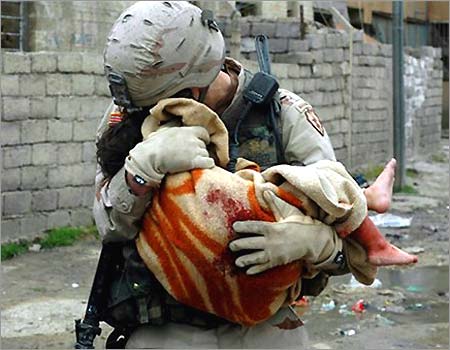
Children bearing the cost of politics and war: the Holy Innocents and a Peace Procession

Amplify

Many Christians think that Jesus did not enter into the political fray. No disparaging name-calling for him.  I can't stand the "Gentle Jesus meek and mild" version of Christianity, particularly as portrayed in modern forms as a gentle-faced, fairish blue-eyed Jesus. The scriptures might say He was meek - but do we understand what that word means to-day?  And Jesus was certainly far from mild.  In Luke 13:32, Jesus refers to the then reigning member of the Herods as a fox.   I wonder where that view, that description came from? 
I think of a family living in Nazareth.  Like all families there are stories and "remember whens".  How huge a thing in the life of the Ben David family it must have been when Joseph and Mary, warned by an angel, fled with their young son into Egypt to escape the massacre of young children by Herod the Great (Matthew 2:13).  There they remained until there was a change in political leadership from Herod the Great to his son, Archelaus.  

When the Ben David family returned from Egypt they did not go back to Bethlehem but to Nazareth.  Even if the boy Jesus had no memory of his own regarding these events, he would have been immersed in his family's history and story.  How could a family have retold this story without making political comment or passing on a view of those who instigated their refugee status?  

The Herod Jesus refers to in Luke is another son of Herod the Great, Antipas: Tetrarch of Galilee and Perea; political opportunist and collaborator under Roman rule in Judaea.  Surely, Herod Antipas was a fox indeed: sly, wily, treading warily through the pitfalls and pratfalls of Roman rule.  Would the Herods have kept alive the story of the massacre of the little children? I think not.  But the Ben David family did. Only by divine intervention did they save a very precious son.

To-morrow, 28 December,  the Massacre of the Holy Innocents is remembered.  The children who died because of the bloodlust and envy of a powerful and wily king have never been forgotten by the Christian church.  
To-morrow in Melbourne, the remembrance will take a contemporary turn:  

Wednesday 28 December, 10 am – 11.30 am: Feast of Holy Innocents Peace Procession 
In the days after Christmas, while most people are recovering from the indulgence of Christmas Day or deeply immersed in the liturgy of the Boxing Day Test, the Church calendar commemorates the Holy Innocents, the children killed by Herod in a bid to maintain his power and privilege. This is a part of the Christmas story which gets little attention in churches, yet it forms a major part of the biblical birth narrative. It is a day when we remember children and other innocent people killed by today’s Herods, who consider such innocents to be acceptable collateral damage in their quest for power and security. Children are still the most deeply affected by wars around the globe – 65% of Afghans are under the age of 18. 90% of those killed in wars are civilians. Join us for a peace procession from Victoria Barracks in Melbourne to Defence Plaza. We will begin at 10 am with prayers at Victoria Barracks on St Kilda Road, and process to Defence Plaza, 661 Bourke St. Melbourne, for further prayer and reflection.
Children of war: fight, dying, surviving 

"The source of most human violence and suffering has been a hidden children's holocaust throughout history, whereby billions of innocent human beings have been routinely murdered, bound, starved, raped, mutilated, battered and tortured by their parents and other caregivers, so that they grow up as emotionally crippled adults and become vengeful time bombs who periodically restage their early traumas in sacrificial rites called wars."
- Lloyd DeMause
Hat Tip to Iain Macadair

Photobucket

Monday, December 26, 2011

The Archbishop of Canterbury: a Christmas message about answering, responding and praying The Prayer Book

Amplify


When the first Christians read – or more probably heard – the opening words of John's gospel, they would have understood straight away quite a lot more than we do. They would have remembered, many of them, that in Hebrew 'word' and 'thing' are the same, and they would all have known that in Greek the word used has a huge range of meaning – at the simplest level, just something said; but also a pattern, a rationale, as we might say, even the entire structure of the universe seen as something that makes sense to us, the structure that holds things together and makes it possible for us to think.
Against this background, we can get a glimpse of just what is being said about Jesus. His life is what God says and what God does; it is the life in which things hold together; it is because of the life that lives in him that we can think. Jesus is the place where all reality is focused, brought to a point. Here is where we can see as nowhere else what connects all reality – all human experience and all natural laws. Edward Elgar famously said about his Enigma Variations that they were all based on a tune that everyone knew – and no-one has ever worked out what he meant. But John's gospel declares that the almost infinite variety of the life we encounter is all variations on the theme that is stated in one single clear musical line, one melody, in the life of Jesus of Nazareth. 'In him was life, and the life was the light of men.'
But this shouldn't make us forget entirely the underlying image. The life that lives in Jesus, the everlasting divine agency that is uniquely embodied in him, is like something that is said – a word addressed to us. Because, like any word addressed to us, it demands a response. And the gospel goes on at once to tell us that the expected response was not forthcoming. Before we have even got to Christmas in the words of the gospel we are taken to Good Friday, and to the painful truth that the coming of Jesus splits the world into those who respond and those who don't. Once the word is spoken in the world, there is no way back. Your response to it, says the gospel again and again, is what shows who and what you really are, what is deepest in you, what means most. What we say or do in our response to Jesus is our way of discovering for ourselves and showing to one another what is real in and for us. Like the other gospel writers, John hints very strongly that some people respond deeply and truthfully to Jesus without fully knowing who he is or what exactly they are doing in responding to him; this is not a recipe for tight religious exclusivism. But the truth is still an uncompromising one: if you cannot or will not respond, you are walking away from reality into a realm of trackless fogbound falsehood.
There is the question we cannot ignore. It's been well said that the first question we hear in the Bible is not humanity's question to God but God's question to us, God walking in the cool of the evening in the Garden of Eden, looking for Adam and Eve who are trying to hide from him. 'Adam, where are you?' The life of Jesus is that question translated into an actual human life, into the conversations and encounters of a flesh and blood human being like all others – except that when people meet him they will say, like the woman who talks with him at the well of Samaria, 'Here is a man who told me everything I ever did.' Very near the heart of Christian faith and practice is this encounter with God's questions, 'who are you, where are you?' Are you on the side of the life that lives in Jesus, the life of grace and truth, of unstinting generosity and unsparing honesty, the only life that gives life to others? Or are you on your own side, on the side of disconnection, rivalry, the hoarding of gifts, the obsession with control? To answer that you're on the side of life doesn't mean for a moment that you can now relax into a fuzzy philosophy of 'life-affirming' comfort. On the contrary: it means you are willing to face everything within you that is cheap, fearful, untruthful and evasive, and let the light shine on it. Like Peter in the very last chapter of John's gospel, we can only say that we are trying to love the truth that is in Jesus, even as we acknowledge all we have done that is contrary to his spirit. And we say this because we trust that we are loved by this unfathomable mystery who comes to us in the shape of a newborn child, 'full of grace and truth'.
Finding words to respond to the Word made flesh is and has always been one of the most demanding things human beings can do. Don't believe for a moment that religious language is easier or vaguer than the rest of our language. It's more like the exact opposite: think of St John writing his gospel, crafting the slow, sometimes repetitive pace of a narrative that allows Jesus to change the perspective inch by inch as a conversation unfolds. Or of St Paul, losing his way in his sentences, floundering in metaphors as he struggles to find the words for something so new that there are no precedents for talking about it. Or any number of the great poets and contemplatives of the Christian centuries. It isn't surprising if we need other people's words a lot of the time; and it's of great importance that we have words to hand that have been used by others in lives that obviously have depth and integrity. That's where the language of our shared worship becomes so important.
This coming year we celebrate the 350th anniversary of the Book of Common Prayer. It has shaped the minds and hearts of millions; and it has done so partly because it has never been a book for individuals alone. It is common prayer, prayer that is shared. In its origins, it was meant to be – and we may well be startled by the ambition of this – a book that defined what a whole society said to God together. If the question 'where are you?' or 'who are you?' were being asked, not only individual citizens of Britain but the whole social order could have replied, 'Here we are, speaking together – to recognize our failures and our ideals, to recognize that the story of the Bible is our story, to ask together for strength to live and act together in faithfulness, fairness, pity and generosity.' If you thumb through the Prayer Book, you may be surprised at how much there is that takes for granted a very clear picture of how we behave with each other. Yes, of course, much of this language feels dated – we don't live in the unselfconscious world of social hierarchy that we meet here. But before we draw the easy and cynical conclusion that the Prayer Book is about social control by the ruling classes, we need to ponder the uncompromising way in which those same ruling classes are reminded of what their power is for, from the monarch downwards. And the almost forgotten words of the Long Exhortation in the Communion Service, telling people what questions they should ask themselves before coming to the Sacrament, show a keen critical awareness of the new economic order that, in the mid sixteenth century, was piling up assets of land and property in the hands of a smaller and smaller elite.
The Prayer Book is a treasury of words and phrases that are still for countless English-speaking people the nearest you can come to an adequate language for the mysteries of faith. It gives us words that say where and who we are before God: 'we have erred and strayed from thy ways like lost sheep', 'we are not worthy so much as to gather up the crumbs under thy table', but also, 'we are very members incorporate in the mystical body of thy Son, which is the blessed company of all faithful people; and are also heirs through hope of the everlasting kingdom'. It gives us words for God that hold on to the paradoxes we can't avoid: 'God... who art always more ready to hear than we to pray,' 'who declarest thy almighty power most chiefly in showing mercy and pity, 'whose property is always to have mercy.' A treasury of words for God – but also a source of vision for an entire society: 'Give us grace seriously to lay heart the great dangers we are in by our unhappy divisions'; 'If ye shall perceive your offences to be such as are not only against God but also against your neighbours; then ye shall reconcile yourselves unto them; being ready to make restitution'.
The world has changed, the very rhythms of our speech have changed, our society is irreversibly more plural, and we have – with varying degrees of reluctance – found other and usually less resonant ways of talking to God and identifying who we are in his presence. If we used only the Prayer Book these days we'd risk confusing the strangeness of the mysteries of faith with the strangeness of antique and lovely language. But we're much the poorer for forgetting it and pushing it to the margins as much as we often do in the Church. And it is crucial to remember the point about the Prayer Book as something for a whole society, binding together our obligations to God and to one another, in a dense interweaving of love and duty joyfully performed.
The Prayer Book was once the way our society found words to respond to the Word, to say who and where they were in answer to God's question. Those who prayed the Prayer Book, remember, included those who abolished the slave trade and put an end to child labour, because of what they had learned in this book and in their Bibles about the honour of God and of God's children. They knew their story; they knew how to give an answer for themselves, how to join up the muddle of their experience in a coherent pattern by relating it to the unchanging truth and grace of God. That's why the coming year's celebration is not about a museum piece.
The most pressing question we now face, we might well say, is who and where we are as a society. Bonds have been broken, trust abused and lost. Whether it is an urban rioter mindlessly burning down a small shop that serves his community, or a speculator turning his back on the question of who bears the ultimate cost for his acquisitive adventures in the virtual reality of today's financial world, the picture is of atoms spinning apart in the dark.
And into that dark the Word of God has entered, in love and judgment, and has not been overcome;
in the darkness the question sounds as clear as ever,
to each of us and to our church and our society:  
'Britain, where are you?' Where are the words we can use to answer? 
© Rowan Williams 2011


Photobucket